Epoxy Floor Finish Explained: What It Means for Bahrain
Picture sweeping endless fine dust out of a concrete garage in Isa Town, or dealing with hydraulic oil spills that permanently stain a commercial warehouse floor in Sitra. Untreated concrete is fundamentally a rigid sponge; it sheds dust constantly and absorbs liquids instantly. An epoxy floor finish solves this by applying a thermosetting resin directly over prepared concrete that chemically cures to form a continuous, impermeable, and structurally rigid surface.
Property owners and facility managers turn to this solution because they need a flooring system that survives Bahrain's extreme 45°C+ summer heat, high humidity, and heavy mechanical wear without degrading. Understanding the difference between a true chemical epoxy bond and standard floor paint dictates whether your investment will last a decade or peel off in six months under the weight of a hot car tire.
What an Epoxy Floor Finish Actually Means
When contractors talk about epoxy, they are not talking about drying paint. They are talking about a controlled chemical reaction that fundamentally alters the top layer of your concrete slab.
The Exothermic Reaction: Cross-Linking Resin and Polyamine Hardener
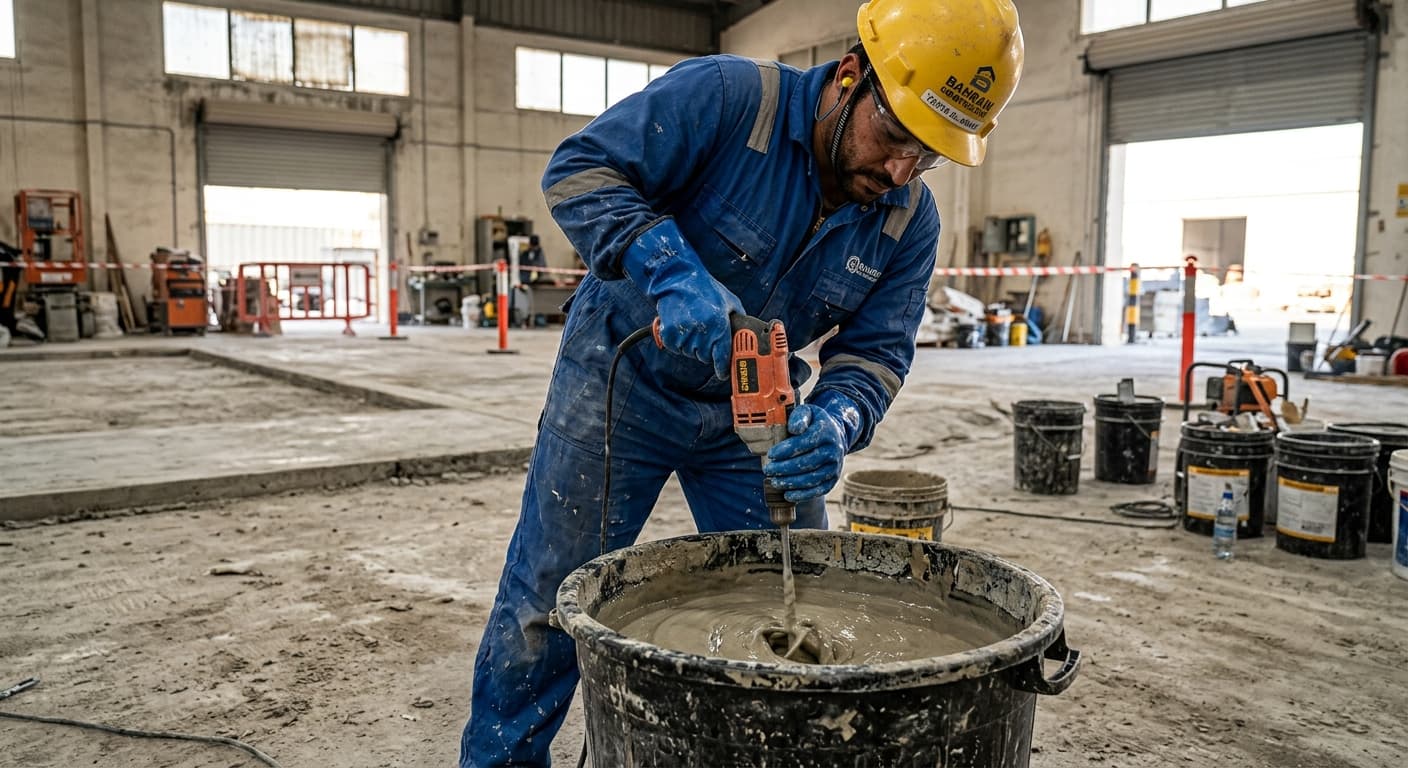
A true epoxy floor finish requires mixing two distinct components: a liquid epoxide resin and a polyamine hardener. When combined, they trigger an exothermic (heat-producing) reaction that forces the molecules to cross-link, transitioning the liquid into a rigid, highly dense plastic.
Because this cross-linking process creates an incredibly tight molecular structure, engine oil, transmission fluid, and harsh cleaning chemicals cannot penetrate the surface. If you use a single-component product that simply air-dries, you do not get this cross-linking, leaving the floor vulnerable to chemical degradation.
Thickness Standards: Differentiating 2mm Coatings from 5mm Heavy-Duty Mortars
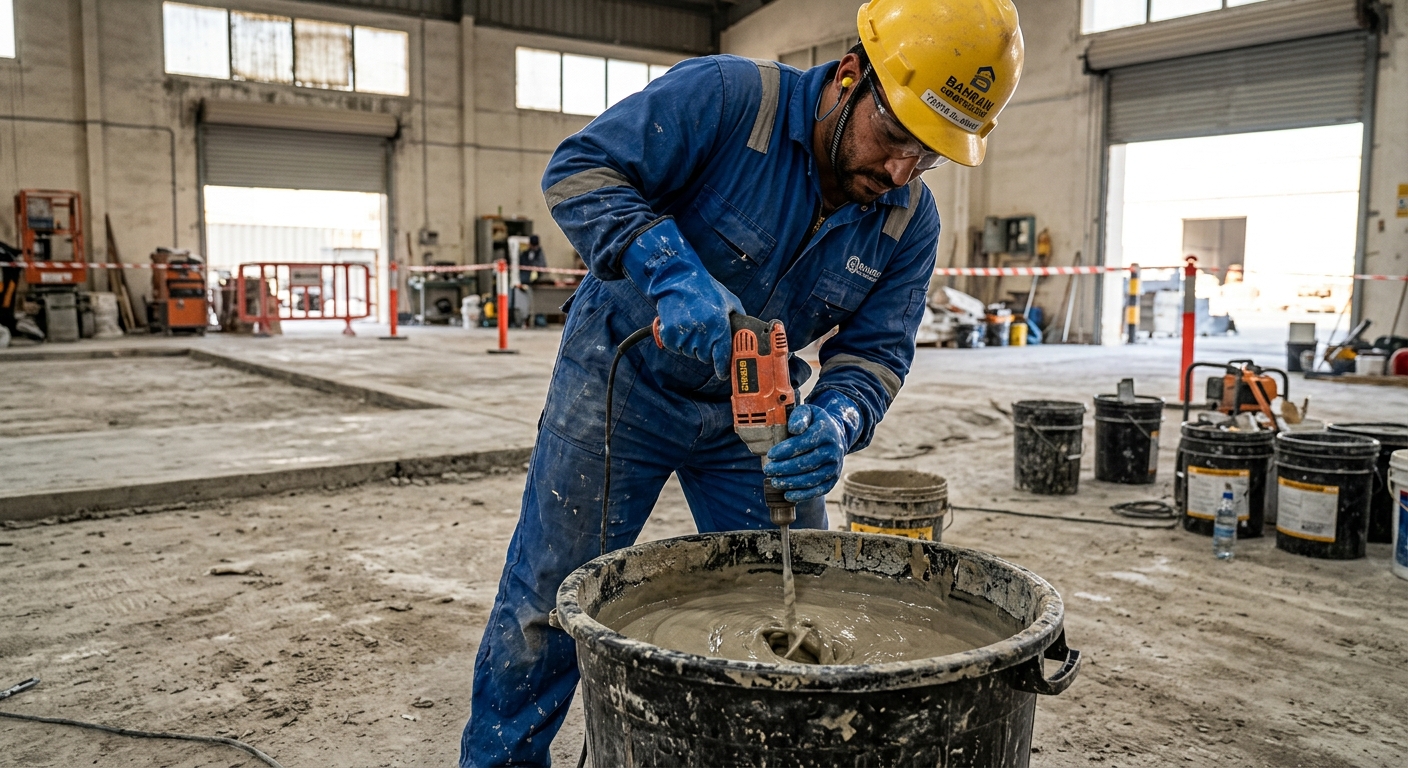
The thickness of your application determines what kind of abuse the floor can handle. A standard 2mm roll-on epoxy coating works perfectly for residential garages or light-duty storage, providing chemical resistance and dust-proofing.
However, if you are running heavy machinery or dropping tools, a 2mm coating will crack under point-load impact. For high-impact environments, you must specify an epoxy mortar system—typically 5mm to 8mm thick—which blends the resin with graded quartz sand.
The Tradeoff:
- 2mm Coatings: Lower upfront cost and faster installation, but you give up impact resistance. Dropping a heavy steel wrench will likely chip the coating down to the concrete.
- 5mm Mortars: Can withstand forklift traffic and heavy impacts, but requires specialized trowel application that roughly triples the installation cost.
How Epoxy Works in Bahrain's Aggressive Climate
Installing an epoxy floor finish in the Gulf requires managing environmental variables that European or North American specifications often ignore. Failure to adapt to local conditions guarantees delamination.
Mechanical Profiling: Why Diamond Grinding is Mandatory for Concrete Adhesion
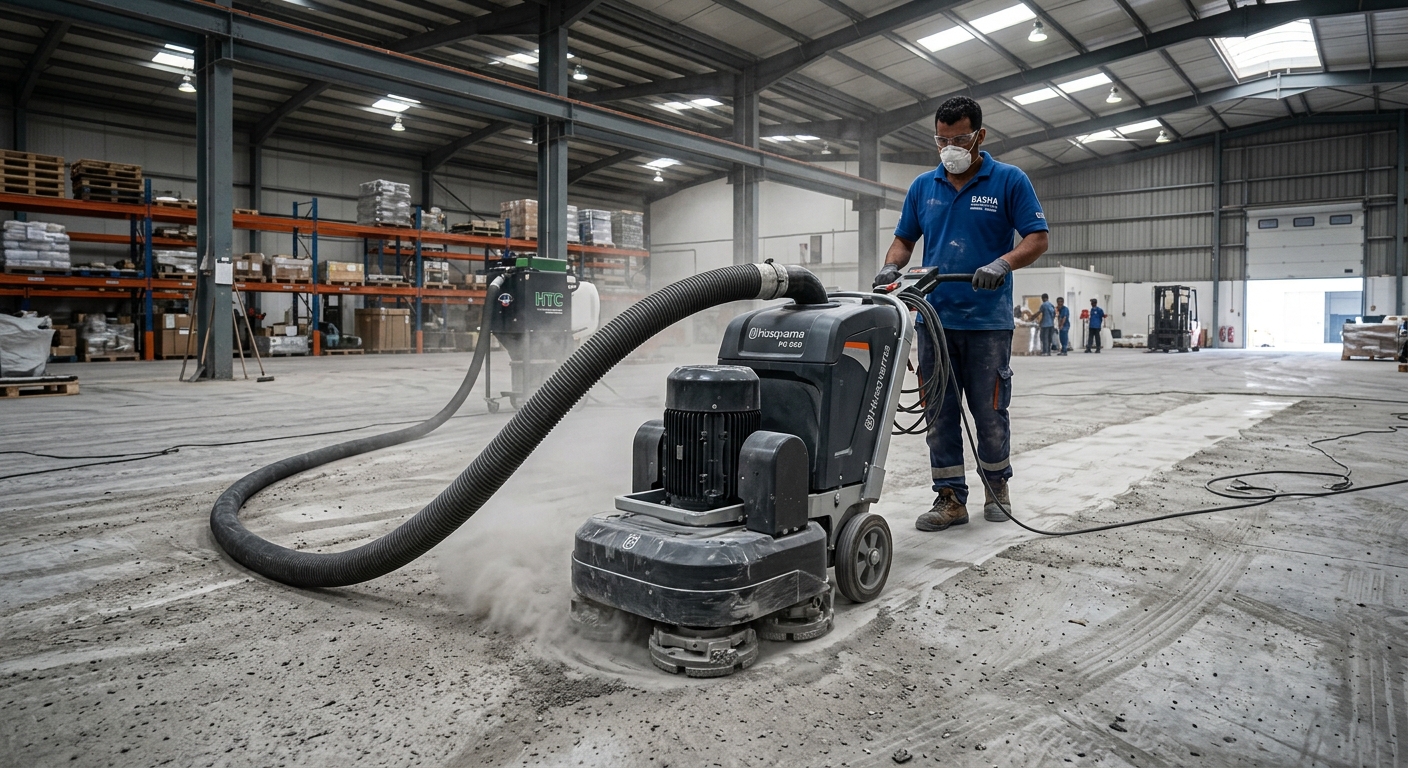
Epoxy cannot bond to smooth, unprepared concrete; it requires a rough, porous surface to act as a mechanical anchor. In practice, this means your contractor must use heavy planetary diamond grinders to remove the top layer of the slab and expose the concrete pores.
Many budget contractors suggest "acid etching" to save time and equipment costs. Never accept acid etching in Bahrain. The local concrete mixes often contain additives that react poorly with acid, leaving a weak, powdery layer (laitance) on the surface; the epoxy will bond to this weak dust instead of the solid slab and peel away within months. Demand a Concrete Surface Profile (CSP) of 3 or 4, achieved exclusively through mechanical grinding.
Combating 80%+ Humidity and Dew Point Constraints During the 24-Hour Cure Time
Bahrain's coastal humidity is the natural enemy of curing epoxy. If moisture condenses on the wet epoxy before it fully cross-links, it causes a chemical failure known as "amine blush"—leaving the floor cloudy, sticky, and structurally compromised.
To avoid this, the concrete slab temperature strictly must be at least 3°C above the ambient dew point during the entire 24-hour curing window. If a contractor tries to pour epoxy in a non-climate-controlled Sitra warehouse at 8 PM in August without monitoring the dew point, you are almost guaranteed to suffer an amine blush failure.
Common Misconceptions About Epoxy Floor Finish
Most epoxy failures are not product failures; they are specification failures driven by a misunderstanding of how the materials interact with their environment.
The 'Epoxy Paint' Myth: Why Hardware Store DIY Kits Fail Under Hot Tires
The most expensive mistake homeowners make is buying cheap "epoxy paint" kits from local hardware stores for their garages. These products are usually just acrylic latex paint with a tiny percentage of epoxy added for marketing purposes.
When you drive a car in Bahrain during July, the tires heat up to 60°C+ on the asphalt. When you park on a cheap DIY coating, the hot rubber expands, grips the thin paint, and then contracts as it cools overnight. The next time you reverse, the tire literally tears the coating off the concrete—a mechanism known as "hot tire pickup." A true two-part commercial epoxy floor finish has a tensile strength higher than the concrete itself, making hot tire pickup impossible.
Ignoring Moisture Vapor Transmission Rates (MVTR) in Reclaimed Coastal Areas
In areas built on reclaimed land, such as Diyar Al Muharraq or Bahrain Bay, the water table sits just centimeters below the slab. Moisture constantly travels upward through the concrete as vapor, creating hydrostatic pressure.
Because epoxy is impermeable, it traps this rising moisture. If the Moisture Vapor Transmission Rate (MVTR) exceeds 3 lbs per 1,000 square feet, the trapped pressure will physically pop the epoxy off the floor, creating large, water-filled blisters. Always demand a calcium chloride moisture test before installation; if the reading is high, you must pay for a specialized moisture-mitigating primer before the epoxy goes down.
Why This Matters: Practical Implications and Investment
Deciding to install an epoxy floor finish requires aligning your operational needs with your budget. It is a permanent structural modification, not a cosmetic facelift.
Calculating the True Cost: Budgeting BD 4 to BD 12 per Square Meter Installed
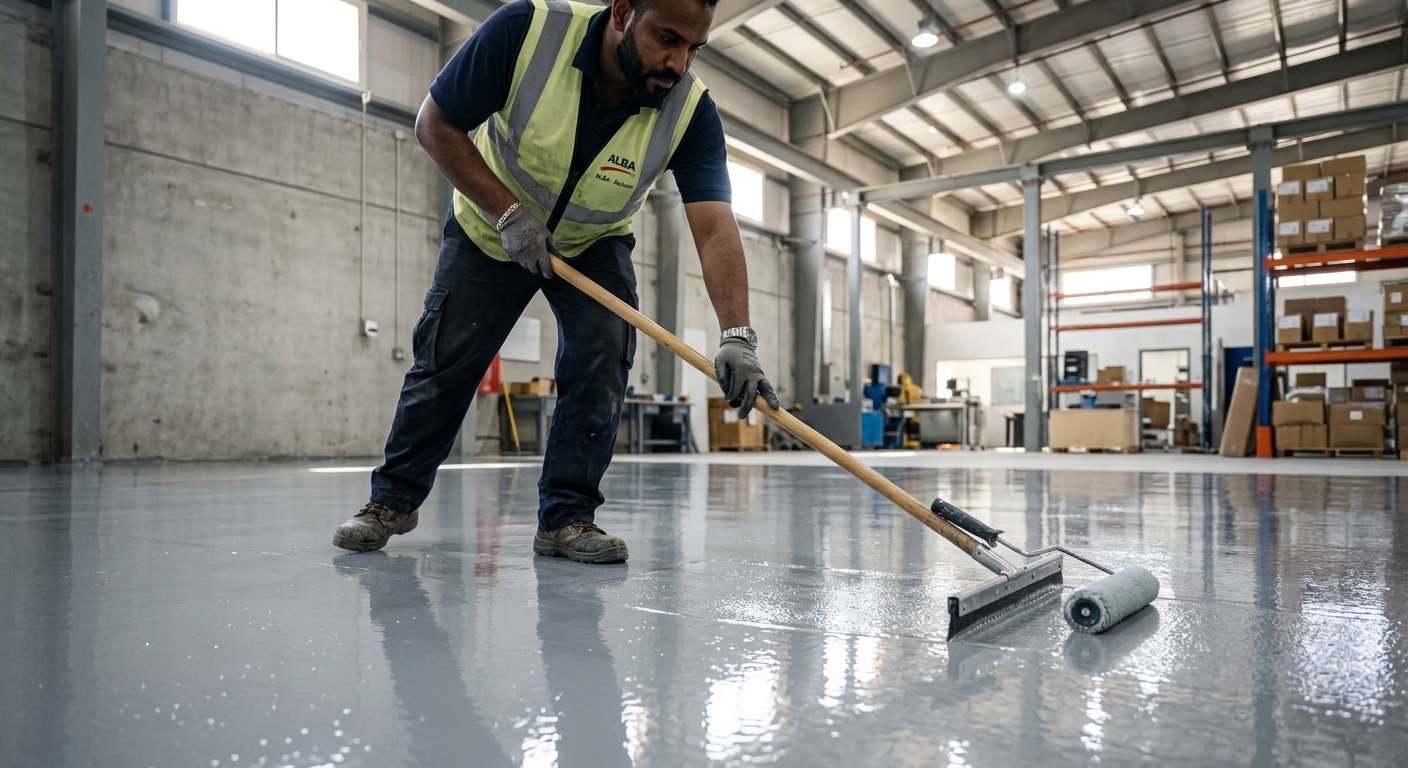
In the Bahrain market, you should expect to pay between BD 4 and BD 12 per square meter for a professionally installed system. The massive variance in price comes down to surface preparation and material thickness.
A BD 4/sqm quote usually covers basic grinding, one coat of primer, and one thin topcoat—ideal for light foot traffic. A BD 12/sqm quote includes heavy diamond grinding, moisture mitigation, a thick epoxy base coat, broadcast slip-resistant aggregates, and a UV-stable topcoat. Choosing the BD 4 option for a commercial warehouse is a false economy; the forklift traffic will destroy it in under a year, forcing a costly removal and re-installation.
Maintenance Protocols for High-Dust Environments Like Riffa and Hidd
While epoxy is highly durable, it is not scratch-proof. In exposed areas like Riffa or Hidd, Shamal winds constantly blow fine silica sand into facilities.
When vehicle tires or heavy boots grind this sand into an epoxy floor finish, it acts like sandpaper, dulling the gloss and creating micro-scratches where dirt accumulates. To prevent this, facility managers must implement strict daily dust-mop protocols. If you know your facility cannot maintain this cleaning schedule, you must specify a matte aliphatic polyurethane topcoat, which hides micro-scratches significantly better than high-gloss epoxy.
Examples in Practice Across Local Industries
Different operational environments dictate entirely different epoxy formulations. Specifying the wrong system for your industry will lead to regulatory fines or safety hazards.
Meeting Ministry of Health Sanitation Standards in Adliya Commercial Kitchens
Commercial kitchens in Adliya face strict Ministry of Health inspections regarding sanitation. Standard tile floors fail these inspections because the grout lines harbor bacteria, and 90-degree floor-to-wall joints trap food waste and stagnant water.
The solution is a seamless epoxy floor finish that incorporates "coving"—where the epoxy is troweled up the wall by 10 centimeters to create a smooth, curved transition. This eliminates corners where bacteria breed and allows staff to aggressively pressure-wash the facility without water seeping under baseboards. In these environments, you must also specify an antimicrobial additive mixed directly into the liquid resin.
Designing Forklift-Rated Impact Resistance for Sitra Industrial Warehouses
A logistics warehouse in Sitra operating 3-ton forklifts requires a vastly different approach than a kitchen. Standard smooth epoxy becomes dangerously slick when hydraulic fluid or water spills on it, creating a severe slipping hazard for heavy machinery.
In this scenario, contractors must install a "broadcast system." While the epoxy base coat is still wet, workers broadcast silica quartz sand until the floor is completely covered. Once cured, the excess sand is swept away, and a final lock-coat of epoxy is applied over the top. This creates a deeply textured, sandpaper-like finish that provides aggressive traction for forklift tires, even when coated in oil.
Conclusion
The core insight is that an epoxy floor finish is a permanent structural modification to your concrete slab, not a temporary cosmetic layer. When properly specified, it transforms a dusty, porous liability into a highly durable asset capable of withstanding Bahrain's harsh industrial and climatic demands.
Before committing to an installation, you must force your contractor to test the concrete for moisture vapor transmission and explicitly budget for professional mechanical diamond grinding. Finally, recognize the limitations of the material: standard epoxy will rapidly turn yellow and chalky if exposed to direct sunlight. For those dealing with outdoor spaces, open loading bays, or areas with heavy window sunlight, demanding an aliphatic polyurethane topcoat as a UV-stable companion to your epoxy base is the mandatory next step to protect your investment.