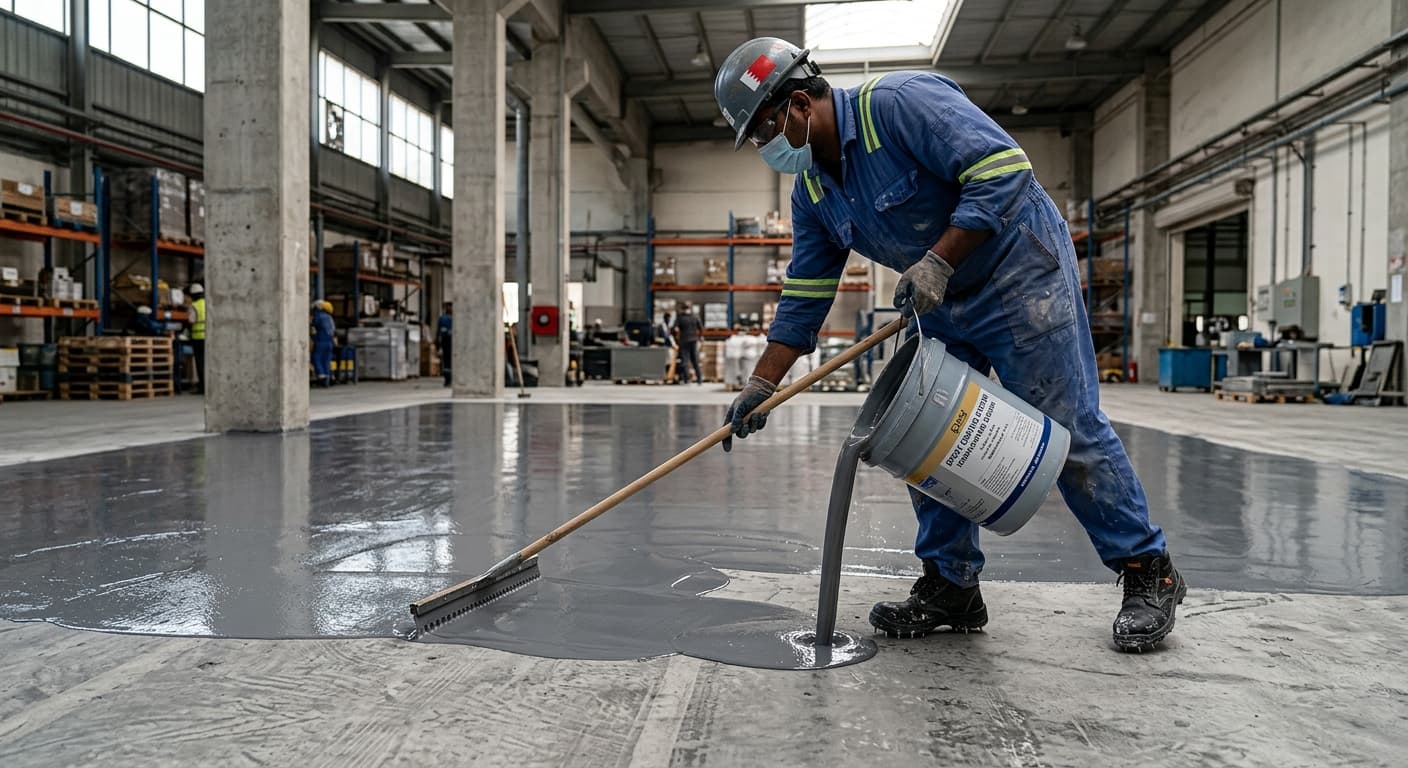
Self Leveling Epoxy Resin Flooring Explained for Bahrain
Imagine upgrading a warehouse in Sitra or a modern residential build in Saar, only to watch your new floor crack and peel after one intense summer of 45°C heat and heavy air conditioning usage. A self leveling epoxy resin flooring system solves this by utilizing a pourable two-part chemical mixture that relies on gravity to create a perfectly flat, seamless surface that cures significantly harder than standard concrete. Property managers and homeowners typically search for this solution when deciding whether to invest in a premium seamless floor versus traditional tiles or standard epoxy paint. Understanding the chemical cross-linking process behind this flooring reveals why it isn't merely a surface decoration, but a structural upgrade that dictates long-term maintenance costs and operational safety.
What Self Leveling Epoxy Resin Flooring Actually Means
The flooring industry frequently confuses thin protective paints with structural resin systems. A true self leveling epoxy resin flooring installation relies on fluid dynamics and sufficient material volume to physically correct the imperfections of the concrete slab beneath it.
The 2mm Minimum Thickness Threshold
A floor cannot self-level if there isn't enough liquid mass to flow across the room. To achieve a perfectly flat surface, you must pour the resin to an absolute minimum thickness of 2mm.
If a contractor quotes you for a 0.5mm or 1mm "self-leveling" floor, they are actually selling you a roll-on coating that will simply mirror every dip, trowel mark, and crack already present in your concrete. At 2mm or thicker, the liquid mass has enough weight to settle into depressions while maintaining a flat top surface, absorbing minor substrate variations entirely.
Gravity-Assisted Surface Correction
The mechanism that makes this floor perfectly smooth is surface tension combined with gravity. When poured, the liquid polymer spreads and seeks its own level before the chemical curing process locks it into place.
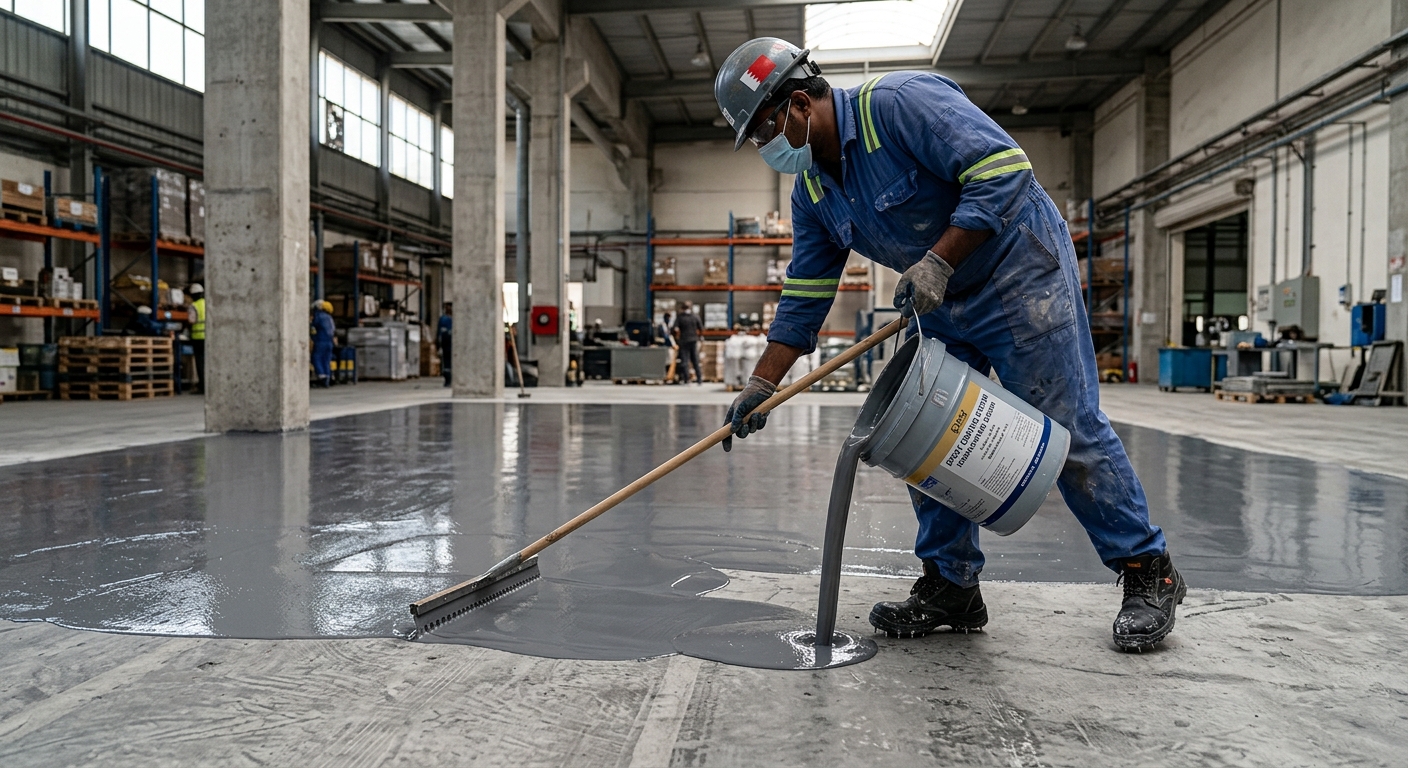
Because it behaves like a liquid seeking a level state, you must establish physical boundaries or dams at doorways and drains before pouring. If a room has an intentional slope toward a drain—common in commercial kitchens or washdown areas—a self-leveling system will fight that slope, pooling at the lowest point and leaving the higher areas bare.
Why the Cured Resin Outperforms 30 MPa Bahraini Concrete
Standard structural concrete in Bahrain is typically rated around 30 to 40 MPa (Megapascals) in compressive strength, but it remains highly porous and susceptible to point-load crushing from forklift tires or heavy machinery. Cured epoxy resin cross-links into a dense plastic matrix that routinely exceeds 60 MPa.
This means the resin does not just sit on the concrete; it acts as an impenetrable armor that distributes heavy, concentrated loads across a wider area of the weaker concrete beneath it. When you drop a heavy tool on standard concrete, it chips; when you drop it on an epoxy system, the impact energy disperses through the polymer matrix, preventing substrate failure.
The Exothermic Mechanism Behind the Pour
You are not drying a liquid; you are initiating a controlled chemical fire. The transformation from liquid to solid plastic is an exothermic reaction, meaning it generates its own heat to force the molecules to bind together.
The Two-Part Cross-Linking Chemical Reaction
The system requires exact volumetric mixing of a resin base and a hardener. Once these two liquids meet, the cross-linking process begins immediately, generating heat that accelerates the curing time.
If a mixing team leaves the combined liquids in a bucket for too long, the concentrated heat will cause the epoxy to "flash"—boiling, smoking, and hardening inside the bucket within minutes. Installers must mix and immediately pour the material onto the floor to dissipate the heat across a wide surface area.
Managing Fluid Viscosity in High-Temperature Environments
Heat dictates the viscosity and the "pot life" (working time) of the resin. In a typical Bahraini summer, pouring self leveling epoxy resin flooring in an un-air-conditioned space at 40°C will drop your working time from a comfortable 40 minutes down to just 15 minutes.
When the resin cures too fast, it loses its ability to self-level, leaving visible trowel marks, ridges, and trapped air bubbles. To prevent this, you must either schedule pours for the middle of the night when ambient temperatures drop, or run temporary air conditioning to cool the concrete slab to 25°C before mixing begins.
Moisture Vapor Barriers: Blocking Rising Damp from Ground Slabs
Much of Bahrain's coastal and reclaimed land features high water tables, forcing moisture vapor up through porous concrete slabs. If you pour an impermeable epoxy layer directly over a damp slab, the trapped moisture vapor will build hydrostatic pressure until it physically blows the epoxy off the floor in large blisters.
To avoid this, you must test the slab's moisture content. If it exceeds 4%, you are required to install a liquid Damp Proof Membrane (DPM) primer before the main epoxy pour.
- When a DPM makes sense: Any ground-floor slab, reclaimed land, or freshly poured concrete less than 28 days old.
- When a DPM does NOT make sense: Suspended slabs on upper floors with controlled environments below.
- What you give up: The DPM adds roughly BD 2 to BD 3 per square meter to your total installation cost.
Common Misconceptions About Self Leveling Systems
Property owners routinely misdiagnose flooring failures because they treat resin like a heavy-duty paint rather than a structural chemical bond.
The 'Thick Paint' Myth That Leads to Early Delamination
The most common cause of epoxy failure is pouring it over improperly prepared concrete. If you simply sweep or acid-wash a slab before pouring, the epoxy bonds to the weak, dusty top layer of the concrete (laitance) rather than the solid aggregate below.
You must mechanically prepare the surface using heavy diamond grinders or shot blasters to expose the pores of the raw concrete. When hot car tires sit on an improperly prepped floor, the heat softens the weak bond, and the tire literally tears the epoxy off the concrete when the car reverses—a failure mode known as hot-tire pickup.
Why Liquid Epoxy Cannot Fix Structurally Compromised Slabs
A liquid resin will fill a crack, but it will not stop the concrete slab from moving. If your concrete has active expansion joints or structural cracks caused by ground settlement, those exact cracks will "telegraph" straight up through your new epoxy floor within months.
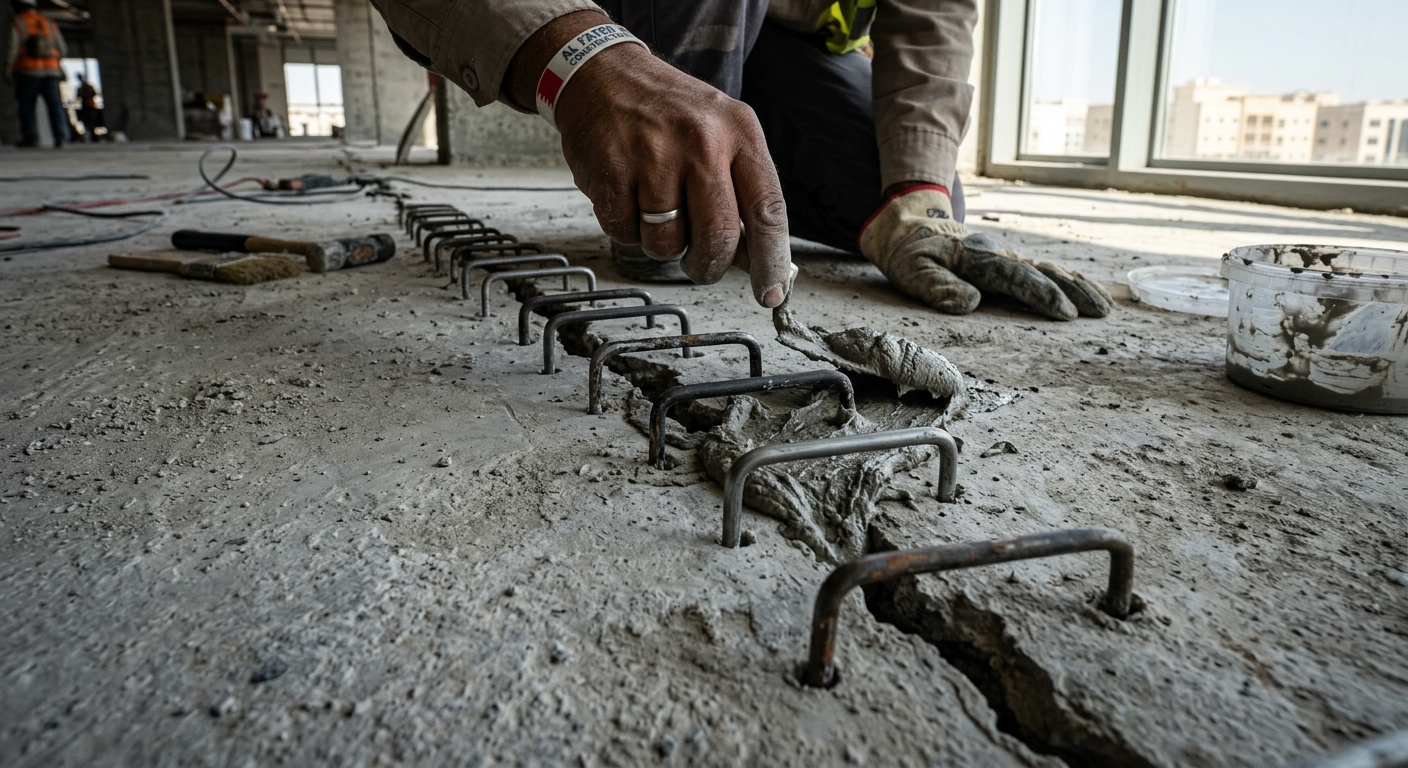
Before pouring, you must chase existing cracks with a diamond blade, insert metal concrete staples, and fill them with a rigid epoxy mortar. You must also honor existing expansion joints by cutting through the finished epoxy and filling the joint with a flexible polyurethane sealant, sacrificing the "seamless" look to prevent uncontrolled cracking.
The Discoloration Reality: UV Degradation in Direct Sunlight
Epoxy resin is highly sensitive to ultraviolet light. If exposed to direct sunlight through large villa windows or open warehouse bay doors, the chemical structure degrades, causing a clear or grey floor to turn a distinct, permanent amber-yellow.
If your floor receives daily sunlight exposure, a standard epoxy system is the wrong choice for the top layer. You must pay to add an aliphatic polyurethane topcoat—a thin, UV-stable clear coat that blocks the radiation and prevents the yellowing mechanism, though it adds cost and a slight texture to the finish.
Practical Implications for Bahrain Properties
Deciding to install this system requires aligning your budget with the exact mechanical and environmental threats your floor will face.
Budgeting the True Cost: BD 4 to BD 12 per Square Meter
Quotes for self leveling epoxy resin flooring in the local market vary wildly because contractors are pricing entirely different chemical volumes and prep methods.
- BD 4 - BD 6 / sqm: Usually buys a very thin pour (under 1.5mm) with minimal grinding and no moisture barrier. Fails quickly under forklift traffic.
- BD 8 - BD 12 / sqm: Buys a true 2mm-3mm self-leveling system, heavy diamond grinding, a moisture vapor barrier, and a polyurethane topcoat.
Never accept a quote based solely on square meterage; demand the contractor specify the exact millimeter thickness of the final cured system. If they cannot guarantee thickness, they are under-pouring the material to pad their margins.
Preventing Bacterial Growth in High-Humidity Coastal Areas
In food processing facilities or high-end residential kitchens, humidity combined with organic spills creates severe bacterial risks. Traditional tiles rely on grout lines, which are highly porous and absorb contaminated liquids, creating breeding grounds that standard mopping cannot sanitize.
Because an epoxy pour creates an entirely non-porous, monolithic surface, liquids remain entirely on the surface where they evaporate or are easily squeegeed into drains. You eliminate the microscopic voids where bacteria survive, drastically reducing the chemical volume required for daily sanitization.
Surviving Thermal Shock Near Industrial AC Vents
In Bahrain's industrial sector, floors routinely experience extreme temperature swings. When a large industrial chiller or AC unit blasts 16°C air directly onto a floor that was just baking at 40°C, the concrete and the floor covering contract at different rates.
Standard epoxy is rigid and can shear away from the concrete under severe thermal shock. If your facility features blast freezers or extreme temperature cycling, you must upgrade from standard epoxy to a polyurethane concrete system, which has an elasticity profile that perfectly matches the thermal expansion rate of the concrete below it.
Concrete Examples of Self Leveling Floors in Action
Evaluating how this technology performs across different local environments helps narrow down the exact specification required for your project.
Forklift Traffic Zones in Hidd Industrial Warehouses
A warehouse operating heavy reach-trucks with hard polyurethane wheels generates intense point-loading that crushes standard concrete, creating a constant layer of silica dust. By specifying self leveling epoxy resin flooring at a 3mm thickness, facility managers lock the concrete dust beneath a 60 MPa plastic shield. The smooth surface also reduces the wear and tear on forklift tires and internal suspensions, lowering vehicle maintenance costs by eliminating the vibration caused by rough concrete.
Seamless Aesthetic Pours in High-End Saar Villas
Homeowners increasingly use light grey or white self-leveling epoxy to mimic polished concrete without the heavy weight or structural requirements of a concrete pour.

While visually striking, this choice introduces a strict tradeoff: high-gloss epoxy shows micro-scratches from dragged furniture and tracked-in sand much faster than patterned ceramic tiles. To utilize this in a residential setting, you must commit to an aggressive entrance-matting strategy to capture abrasive sand before it reaches the resin.
Chemical Spill Resistance in Sitra Manufacturing Plants
In facilities handling battery acids, industrial solvents, or heavy lubricants, a spill will rapidly eat through the calcium carbonate in bare concrete, creating structural craters. Standard epoxy provides excellent resistance to alkalis and mild acids, creating a barrier that gives staff time to neutralize and wash away the spill before it reaches the slab. However, for highly concentrated sulfuric or nitric acids, standard epoxy will still fail, requiring an upgrade to a specialized novolac epoxy formulation.
Conclusion
The critical insight is that self leveling epoxy resin flooring is a highly engineered chemical system, not just a thick coat of paint. By relying on fluid dynamics and exothermic curing, it transforms uneven, porous concrete into an impenetrable, hygienic monolith capable of surviving Bahrain's demanding industrial and climatic conditions.
Before committing to an installation, you must physically test your concrete slab's moisture content and explicitly define the expected mechanical loads to mandate the correct millimeter thickness. If your space features large windows or open bay doors, budgeting for an aliphatic polyurethane topcoat is the unavoidable next step to prevent rapid UV degradation and secure the lifespan of your investment.