What Is Concrete Epoxy? (Why Bahrain Floors Need It)
If you are constantly sweeping fine white dust off your villa's garage floor in Saar, or watching forklift tires tear up your warehouse surface in Hidd, you are dealing with failing concrete. Unsealed concrete acts like a rigid sponge, absorbing vehicle fluids and shedding microscopic dust particles as it breaks down under friction.
Concrete epoxy acts as a permanent intervention. It is a two-part chemical resin applied to porous concrete that cures into a seamless, high-strength plastic barrier. Property owners and facility managers search for this solution when standard floor paints peel under intense summer heat or when rising ground salinity starts degrading their foundation.
Understanding the chemical reality of a true epoxy system will save you from spending thousands of dinars on a cheap coating that fails after a single Bahraini summer.
More Than Just Floor Paint: The Chemistry of Concrete Epoxy
Hardware stores market acrylic floor paints and true epoxies side-by-side, misleading buyers into thinking they perform similar functions. They do not.
The Resin and Hardener Reaction (Thermosetting Process)
Standard paint dries by evaporation; the water or solvent leaves, and a thin film remains on the surface. Concrete epoxy does not dry—it cures through an exothermic chemical reaction.
When you mix the resin (Part A) with a polyamine hardener (Part B), the liquid rapidly cross-links into a solid, thermosetting polymer. This creates a surface that cannot be melted by heat or dissolved by common chemicals. If a product does not require you to mix two separate components immediately before application, it will not provide industrial-grade protection.
Why Porous Concrete Requires Chemical Bonding
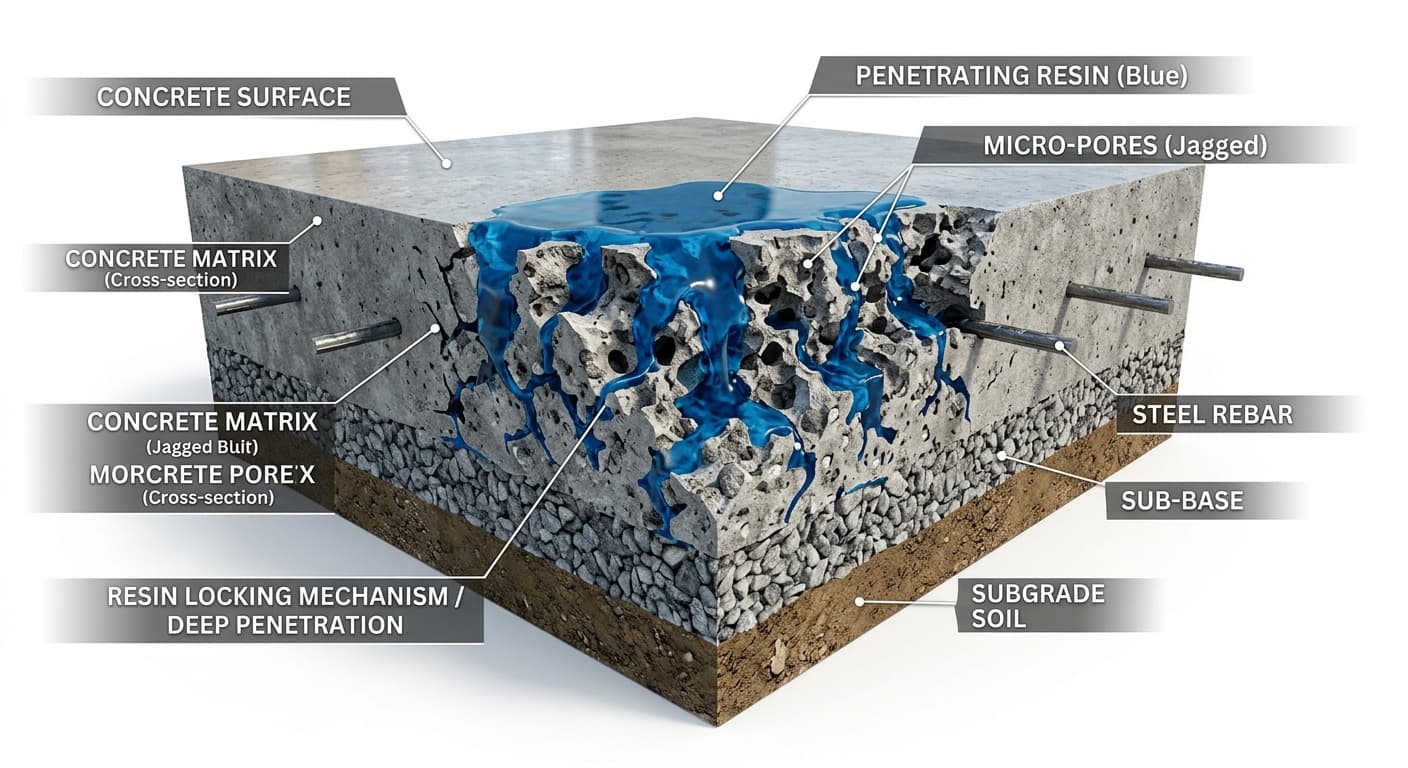
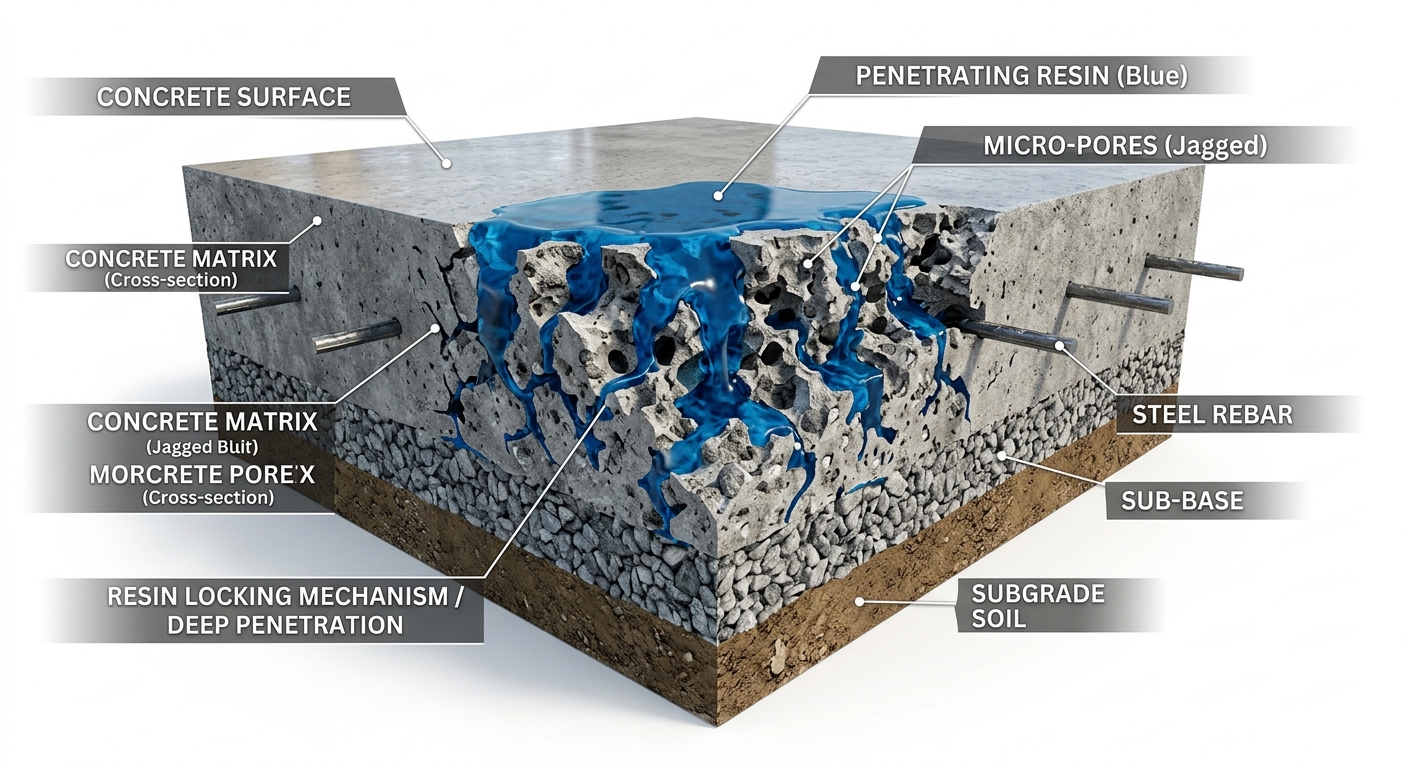
Concrete is highly alkaline and filled with microscopic air pockets. When a properly formulated epoxy primer is applied, it wicks down into these capillaries before the curing process hardens it.
This creates mechanical "roots" inside the slab. The coating is no longer sitting on top of the floor; it becomes physically integrated into the top millimeter of the concrete itself. When heavy machinery turns on the surface, the stress transfers into the slab rather than shearing the coating off.
The 1-Part vs. 2-Part Trap: Epoxy Paint vs. True Epoxy Coatings
Many homeowners buy "1-Part Epoxy Paint" because it is cheap and easy to apply. This usually results in total coating failure within six months.
- 1-Part Acrylic Paint: Sits on the surface, peels under hot tires, costs BD 1-2 per square meter, and requires reapplication annually.
- 2-Part Concrete Epoxy: Penetrates the slab, resists automotive fluids, costs BD 4-12 per square meter, and lasts 10-15 years.
- The Tradeoff: True 2-part systems have a "pot life" of just 30 to 45 minutes once mixed. You trade easy, leisurely application for permanent durability, requiring careful planning and rapid execution.
How Epoxy Transforms Bare Concrete into Armor
A permanent floor is created during the preparation phase, not the painting phase. If a contractor arrives to apply concrete epoxy with only a pressure washer and a roller, send them away.
Creating the Profile: Why Diamond Grinding is Mandatory
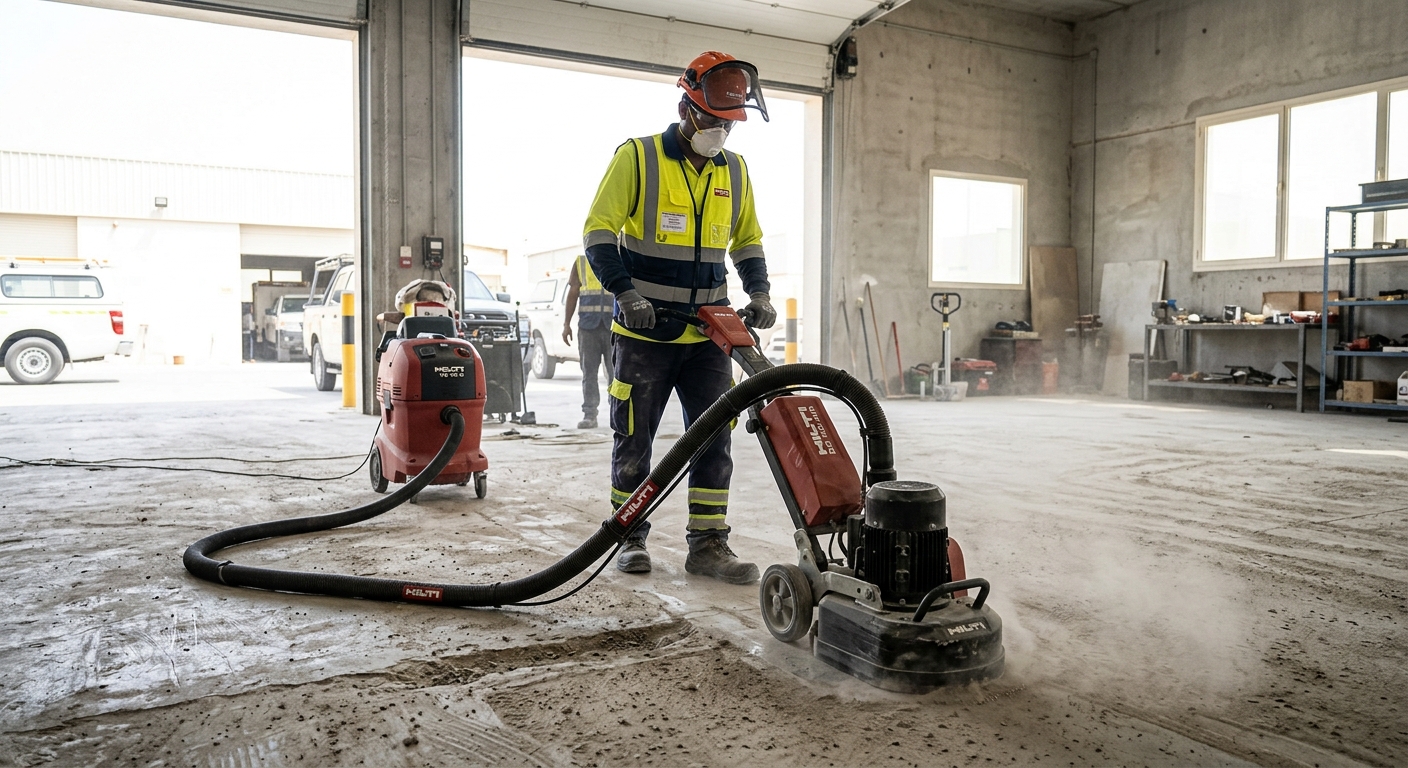
Epoxy cannot bond to smooth, power-troweled concrete. The surface must be mechanically opened to achieve a Concrete Surface Profile (CSP) of 2 or 3, which feels like medium-grit sandpaper.
In practice, this requires heavy floor grinders equipped with diamond tooling to shave off the top layer of the slab. Acid etching is a common shortcut used by cheap contractors, but it introduces massive amounts of water into the slab and rarely provides a deep enough profile for a permanent mechanical bond.
Capillary Penetration: Sealing Concrete Pores from the Inside
Once the pores are exposed, the first layer applied is a low-viscosity primer. This primer acts like water, sinking deep into the concrete structure.
What people underestimate is the outgassing effect. As the epoxy sinks in, it displaces air trapped in the concrete, which bubbles up to the surface. If you skip the primer and apply a thick topcoat immediately, those air bubbles become trapped, leaving permanent craters and weak spots in your finished floor.
Managing the Cure Time Under Bahrain's 80%+ Humidity Conditions
Applying epoxy during a humid Bahraini August introduces a specific failure mode called "amine blush." When moisture in the air interacts with the curing hardener, it forms a sticky, greasy film on the surface.
If a second coat is applied over amine blush, it will delaminate and peel off in sheets. Professional installers prevent this by using moisture-tolerant primers, controlling the ambient temperature with portable AC units, or scheduling applications during specific low-humidity nighttime windows.
The "Peeling Floor" Myth and Other Epoxy Misconceptions
When people complain that their epoxy floor failed, they almost always blame the product rather than the preparation or environmental conditions.
Myth 1: You Can Apply It Directly Over Old Oil Stains
Epoxy repels oil, which means it also refuses to bond to oil-soaked concrete. If you apply a coating over an old engine oil stain in your garage, the epoxy will cure but will not attach to the floor beneath it.
Mechanically grinding the stain is often not enough, as oil penetrates deep into the slab. You must use heavy-duty enzymatic degreasers or flame-treat the area to pull the oil out of the pores before the primer coat touches the floor.
Myth 2: True Epoxy Is Immune to UV Yellowing (The Outdoor Patio Mistake)
When UV radiation hits a standard concrete epoxy, it breaks down the polymer chains. Within months, a clear or light-gray epoxy exposed to the Bahrain sun will turn a sickly amber-yellow and begin to chalk.
If you are coating an outdoor patio, driveway, or a room with massive floor-to-ceiling windows, standard epoxy fails.
- When it makes sense: Indoors, basements, enclosed garages, and warehouses.
- When it does NOT make sense: Uncovered driveways, pool decks, and outdoor walkways.
- What you must do instead: Apply an aliphatic polyurethane or polyaspartic topcoat over the epoxy base. These aliphatic compounds block UV light and prevent the underlying epoxy from degrading.
Myth 3: Hot Tire Pickup Only Happens with Cheap Brands
Hot tire pickup occurs when a car drives on hot asphalt, heating the rubber tires to 60°C or more. When the car parks in a garage, the hot tires expand, grip the floor coating, and shrink as they cool, literally tearing the coating off the concrete.
While cheap paints fail immediately under this stress, even premium concrete epoxy will fail if the initial mechanical bond was weak. Hot tire pickup is a symptom of poor concrete grinding, not a flawed resin.
Why Bahrain's Climate Demands Concrete Protection
Building in the Gulf requires managing aggressive environmental factors that destroy untreated concrete from both the top down and the bottom up.
Blocking Ground Moisture and Salinity (Combating the Sabkha Effect)
Many areas in Bahrain, particularly reclaimed lands, suffer from high soil salinity and high water tables. Through capillary action, salty moisture rises through the concrete slab. When the water evaporates, the salt crystallizes (efflorescence), expanding with enough force to blow the surface off the concrete.
To stop this, a specialized moisture-mitigating epoxy vapor barrier must be applied as the first coat. This dense resin locks the moisture inside the slab, preventing the salt from reaching the surface and destroying your topcoats or interior flooring.
Stopping Concrete Dusting in Enclosed AC Spaces
Untreated concrete constantly sheds microscopic silica dust due to friction from foot traffic and vehicle movement. In enclosed, air-conditioned spaces, this dust is pulled into the HVAC system, clogging filters and degrading air quality.
A seamless epoxy system completely seals the slab, eliminating concrete dusting at the source. This drastically reduces maintenance costs for warehouse cooling systems and keeps residential garages clean.
Budgeting for Professional Installation: BD 4 to BD 12 per Square Meter
Pricing for concrete epoxy in Bahrain varies strictly based on the thickness of the system and the level of surface preparation required.
- BD 4 - 6 per sqm: Covers basic diamond grinding, one primer coat, and one solid-color topcoat. Best for low-traffic storage rooms.
- BD 7 - 9 per sqm: Adds a full vinyl flake broadcast (which hides dirt and adds slip resistance) and a clear protective topcoat. Standard for residential garages.
- BD 10 - 12+ per sqm: Includes heavy mechanical profiling, moisture-vapor barrier primers, and high-build polyurethane topcoats. Required for commercial kitchens or heavy industrial use.
Real-World Epoxy Applications Across Bahrain
Selecting the right system depends entirely on the mechanical and chemical abuse the floor will take.
High-Traffic Logistics Warehouses in Bahrain Investment Wharf
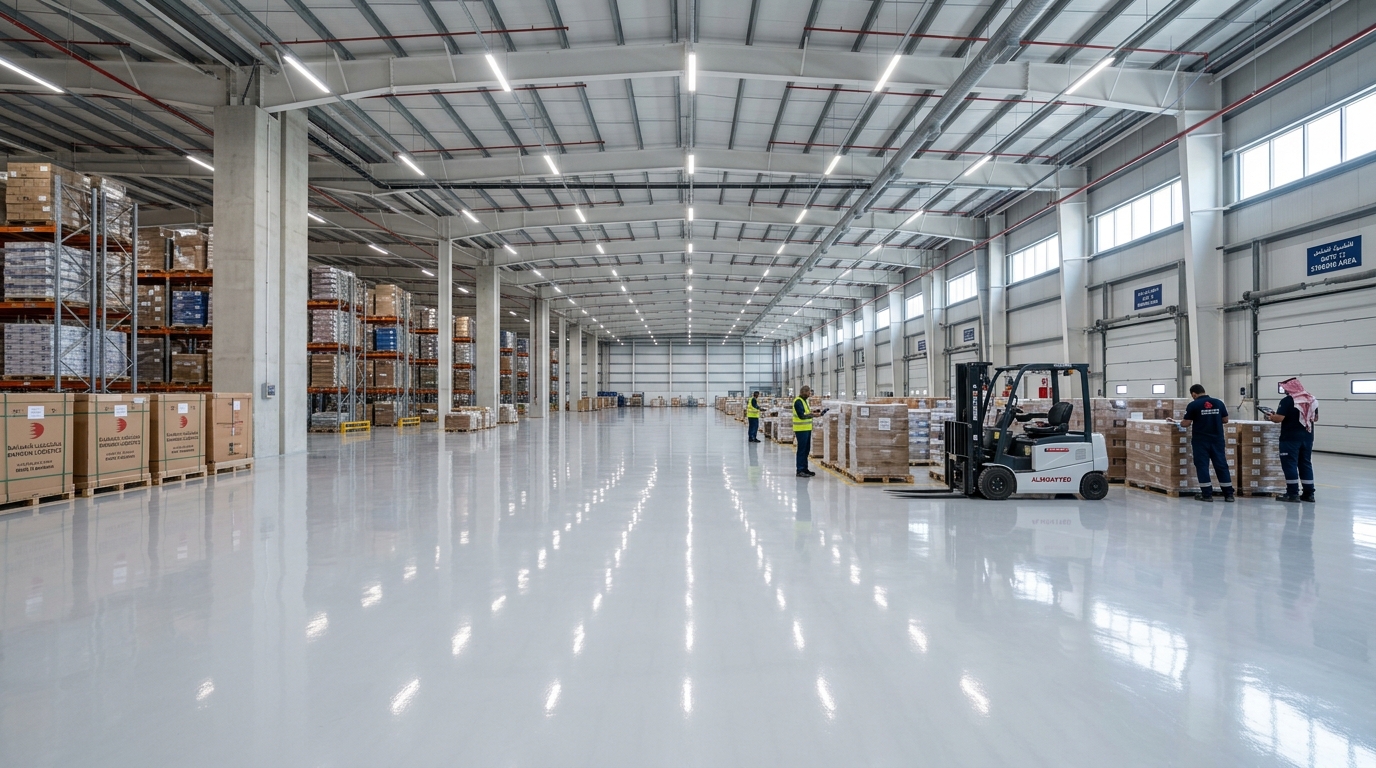
Warehouses managing constant forklift traffic require a high-build epoxy system (2mm to 3mm thick). Forklifts have solid polyurethane wheels that exert massive point-load pressure. A thin coat will shatter under this weight. These facilities use self-leveling concrete epoxy to create a perfectly flat surface, preventing forklift mast sway and protecting the underlying slab from impact damage.
Luxury Villa Garages in Riffa and Amwaj Islands
For high-end residential garages, aesthetics and easy maintenance drive the decision. Homeowners typically install a "flake system."
The contractor applies a tinted epoxy base coat, broadcasts colored vinyl chips into the wet resin until the floor is completely covered, and seals it with a clear, UV-resistant polyaspartic topcoat. This creates a granite-like texture that hides minor dirt, prevents hot tire pickup, and easily wipes clean of leaking power steering fluid.
Commercial Kitchens and Food Processing Facilities in Tubli
Restaurants face a specific threat: thermal shock. When a vat of boiling cooking oil spills onto a floor, or staff wash down the area with high-pressure hot water, standard concrete epoxy expands at a different rate than the concrete beneath it, causing it to crack and debond.
In these environments, standard epoxy is the wrong choice. Facility managers must specify a urethane cement or novolac epoxy system. These specialized coatings handle extreme temperature fluctuations and resist the highly acidic nature of organic food waste and harsh industrial degreasers.
Conclusion
The critical realization is that concrete epoxy is not a cosmetic topcoat; it is a structural upgrade that chemically alters the surface of your floor.
Before investing in a coating, you must assess your concrete's current moisture levels and ensure your contractor explicitly includes mechanical diamond grinding in their quote. If you are planning an application exposed to the intense Bahrain sun, you must factor in the cost of a UV-stable polyurethane topcoat. By treating your floor coating as an engineered system rather than a painting project, you guarantee a surface that will outlast the vehicles driving on it.