What Is Concrete Garage Floor Coating? (Why It Matters)
Sweeping fine desert dust out of a garage only to find a new layer the next day is a frustrating reality for many homeowners in Bahrain. What people underestimate is that this dust isn't just blowing in from the street—it is often the concrete slab itself breaking down. As bare concrete ages under heavy vehicle traffic and extreme heat, the top layer deteriorates, releasing a continuous supply of fine, white powder that tracks into your home and clogs HVAC filters.
A concrete garage floor coating is a chemically bonded resin layer that transforms a porous cement slab into a seamless, impenetrable barrier. Property owners usually seek out this solution when they are tired of endless cleaning, or when hot car tires begin permanently staining their unprotected floors.
Understanding the chemical mechanics behind these coatings shifts the conversation from a simple cosmetic upgrade to a critical structural defense. When you understand how these systems work, you stop wasting money on temporary "garage paints" and learn how to prevent catastrophic peeling and costly concrete replacements in the Gulf's extreme climate.
What Concrete Garage Floor Coating Actually Means
The most expensive mistake homeowners make is treating a garage floor coating like a coat of paint. To make a smart purchasing decision, you must understand the fundamental difference between a surface covering that dries and a protective matrix that cures.
The Chemical Cross-Linking Process vs. Evaporative Drying
Standard paint dries through evaporation; the water or solvent evaporates into the air, leaving a thin, brittle film resting on top of the concrete. A true concrete garage floor coating relies on chemical cross-linking.
When an installer mixes a resin (Part A) with a hardener (Part B), it triggers an exothermic chemical reaction. Instead of drying, the material cures, forming dense polymer chains that structurally fuse with the concrete. If a product does not require mixing two separate components before application, it is not a true coating and will fail under the weight of a vehicle.
Penetrating and Sealing the Porous Concrete Matrix
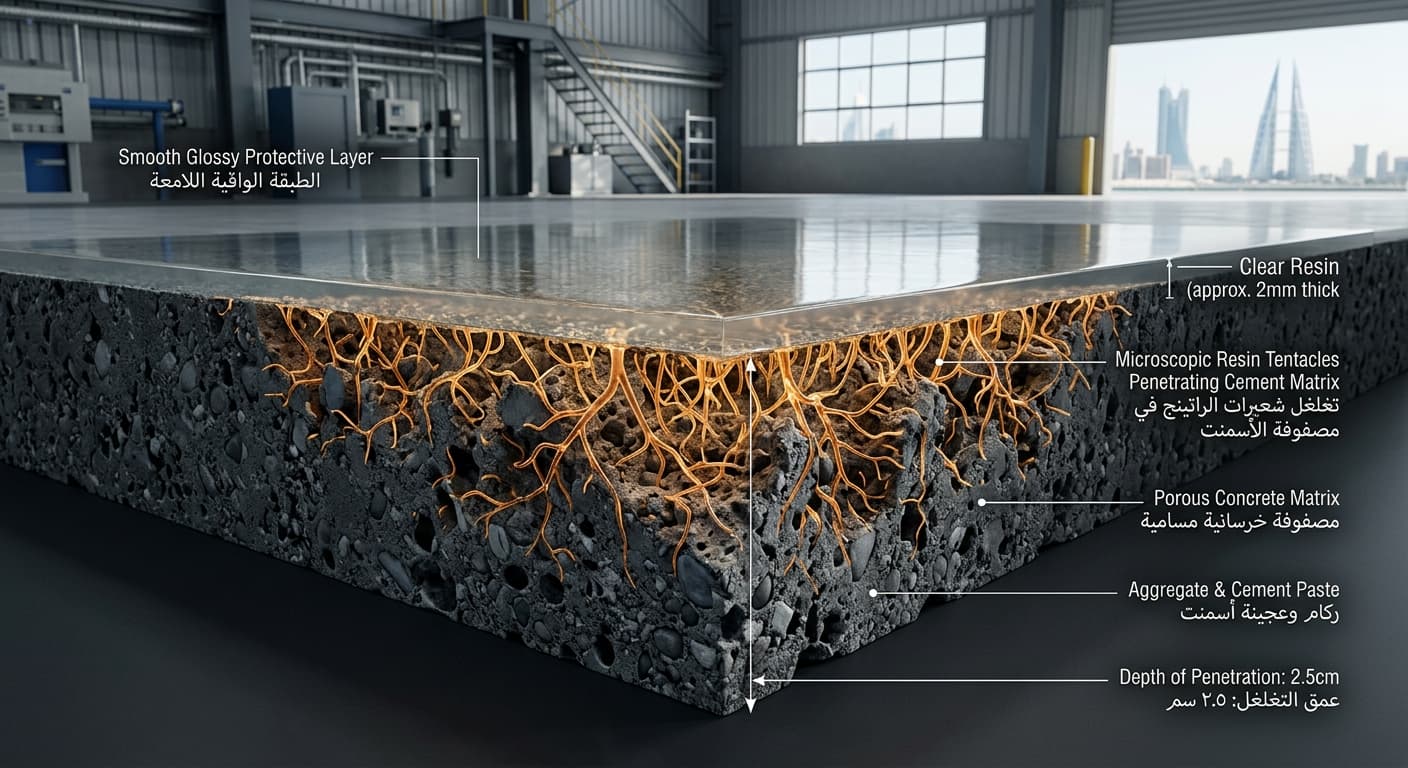
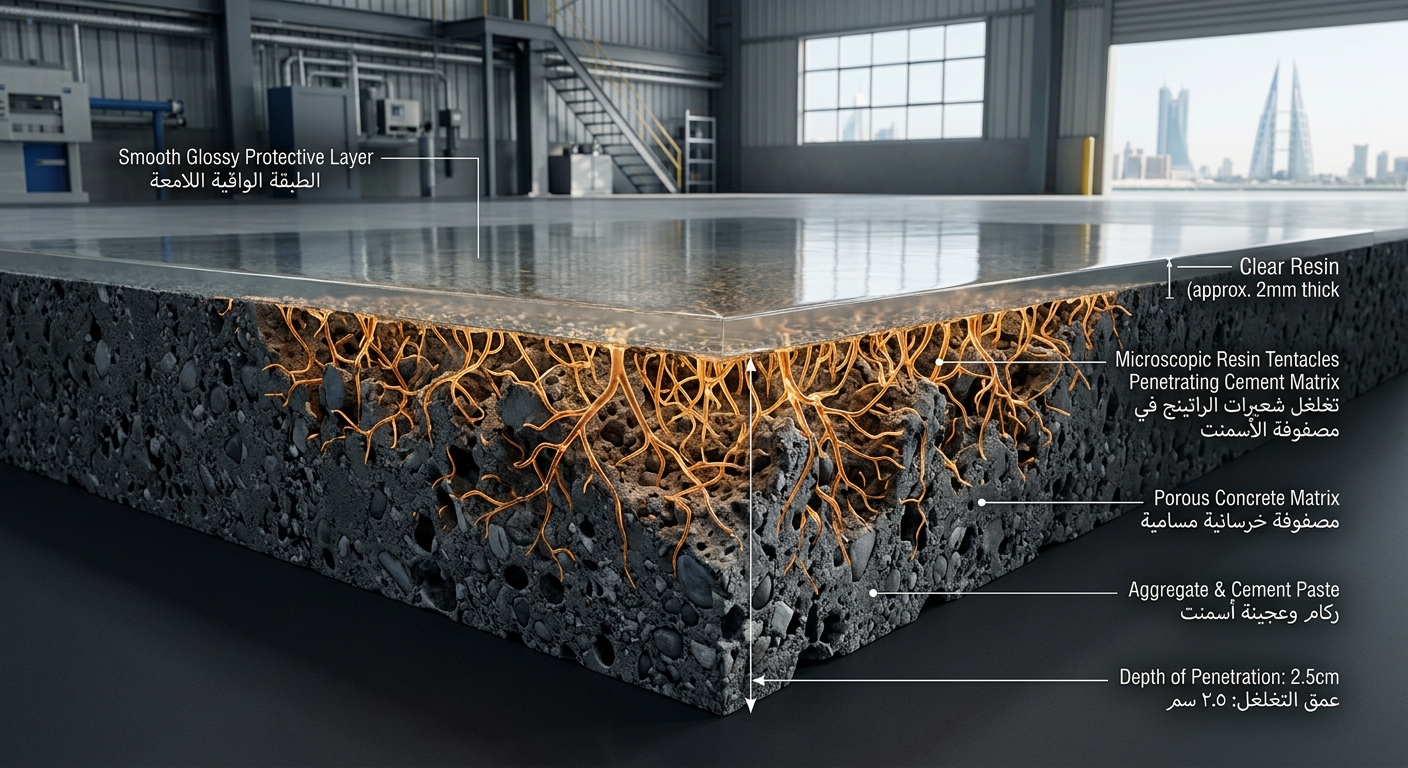
Bare concrete acts like a rigid sponge, full of microscopic capillary channels that absorb engine oil, transmission fluid, and water. A high-quality coating system uses a low-viscosity primer designed to wick deep into these pores before it hardens.
This penetration creates "resin tentacles" that anchor the coating into the slab itself. Without this deep penetration, the coating simply sits on the surface, relying entirely on surface adhesion, which is easily broken by the mechanical stress of turning tires.
How Concrete Garage Floor Coating Works Under Stress
Bahrain’s environment is hostile to building materials. A coating must survive intense temperature fluctuations, heavy mechanical loads, and aggressive subsurface moisture. Here is how professional-grade systems handle these specific stressors.
Thermal Shock Resistance at 50°C Ambient Temperatures
During a Bahraini summer, ambient temperatures routinely hit 45°C to 50°C, and asphalt roads get much hotter. When you drive your car into the garage, the tires transfer this extreme heat directly to the floor.
This rapid temperature transfer causes thermal shock—the concrete and the coating expand at different rates. Professional polyaspartic and pure epoxy resins are engineered with specific flexural strength, allowing them to expand and contract with the concrete slab without snapping or delaminating. Cheap acrylics lack this flexibility and will shatter under thermal stress.
The Mechanics of Hot Tire Pick-Up Prevention
When driving on hot summer roads, your car tires expand and become highly pliable. When you park, the tires cool and contract, physically gripping the surface of the floor.
When you back out the next morning, the tires pull upward on the floor covering with immense force. If the tensile strength of the coating's bond to the concrete is weaker than the tire's grip, the tire rips the coating right off the floor—a failure known as "hot tire pick-up." A chemically bonded concrete garage floor coating prevents this because its adhesion strength exceeds the gripping force of the cooling rubber.
Blocking Subsurface Moisture and High Salinity Vapor
Much of Bahrain is built on reclaimed land with high water tables, meaning moisture constantly pushes up through the ground and into your concrete slab. This moisture carries dissolved salts (chlorides and sulfates) that crystallize just beneath the surface.
If an installer applies a standard coating over a high-moisture slab without a vapor barrier primer, hydrostatic pressure will build up and physically push the coating off the floor, causing massive blisters. A proper coating system includes a moisture-mitigating epoxy primer that blocks vapor transmission, trapping the moisture below the slab where it cannot cause damage.
Common Misconceptions About Garage Coatings
The garage flooring industry is full of misleading marketing that causes homeowners to waste money on systems doomed to fail. Recognizing these failure points is essential for holding your contractor accountable.
The 'Garage Paint' Myth (Why 1-Part Epoxies Peel in Months)
Hardware stores frequently sell "1-part epoxy floor paint" in convenient DIY kits. This is a marketing deception; these products are usually just acrylic paint with a tiny amount of epoxy resin added for marketing purposes.
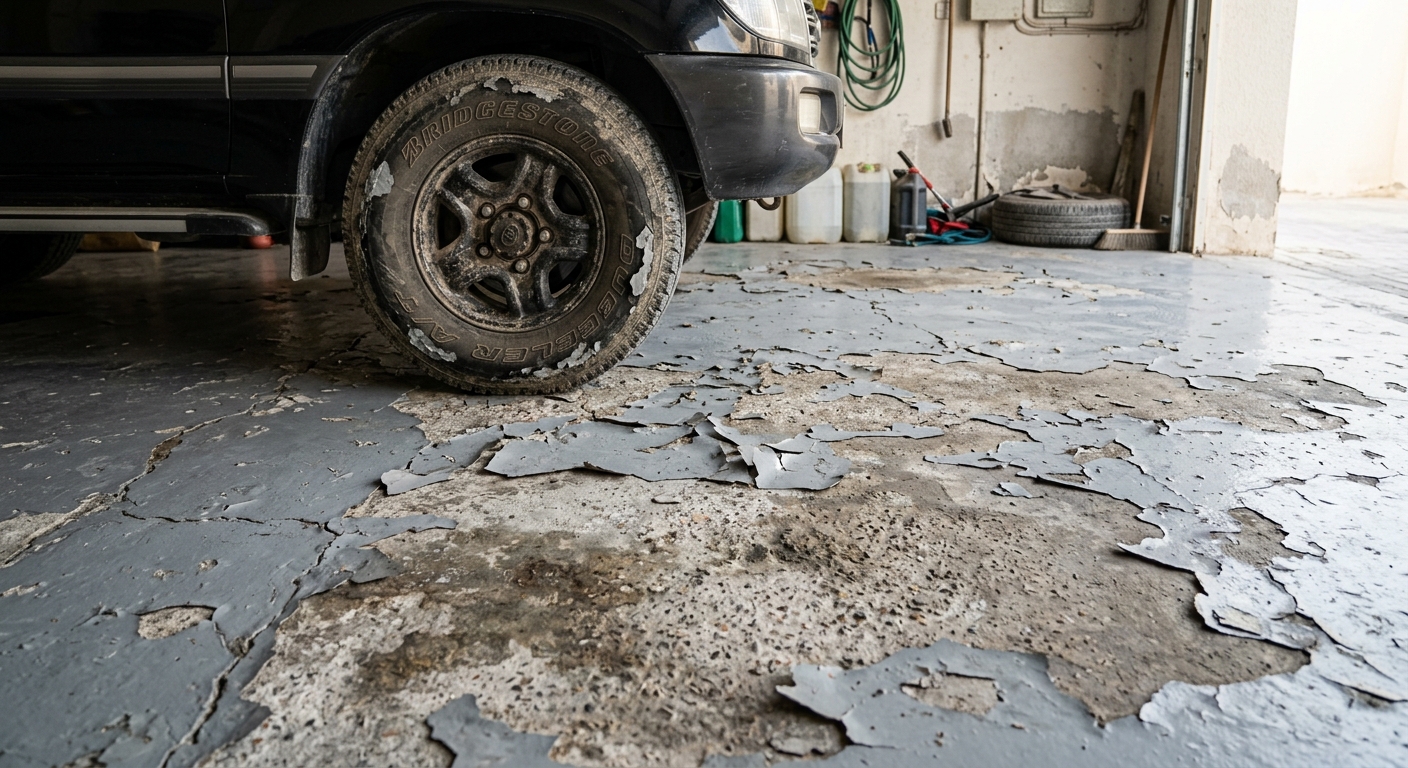
In practice, these 1-part systems lack the chemical cross-linking required to resist vehicle fluids or hot tires. Applying these kits is a guaranteed waste of money, as they typically begin flaking within three to six months in a Gulf climate, leaving you with a floor that looks worse than bare concrete.
Skipping the 16-Grit Diamond Grinding Preparation Phase
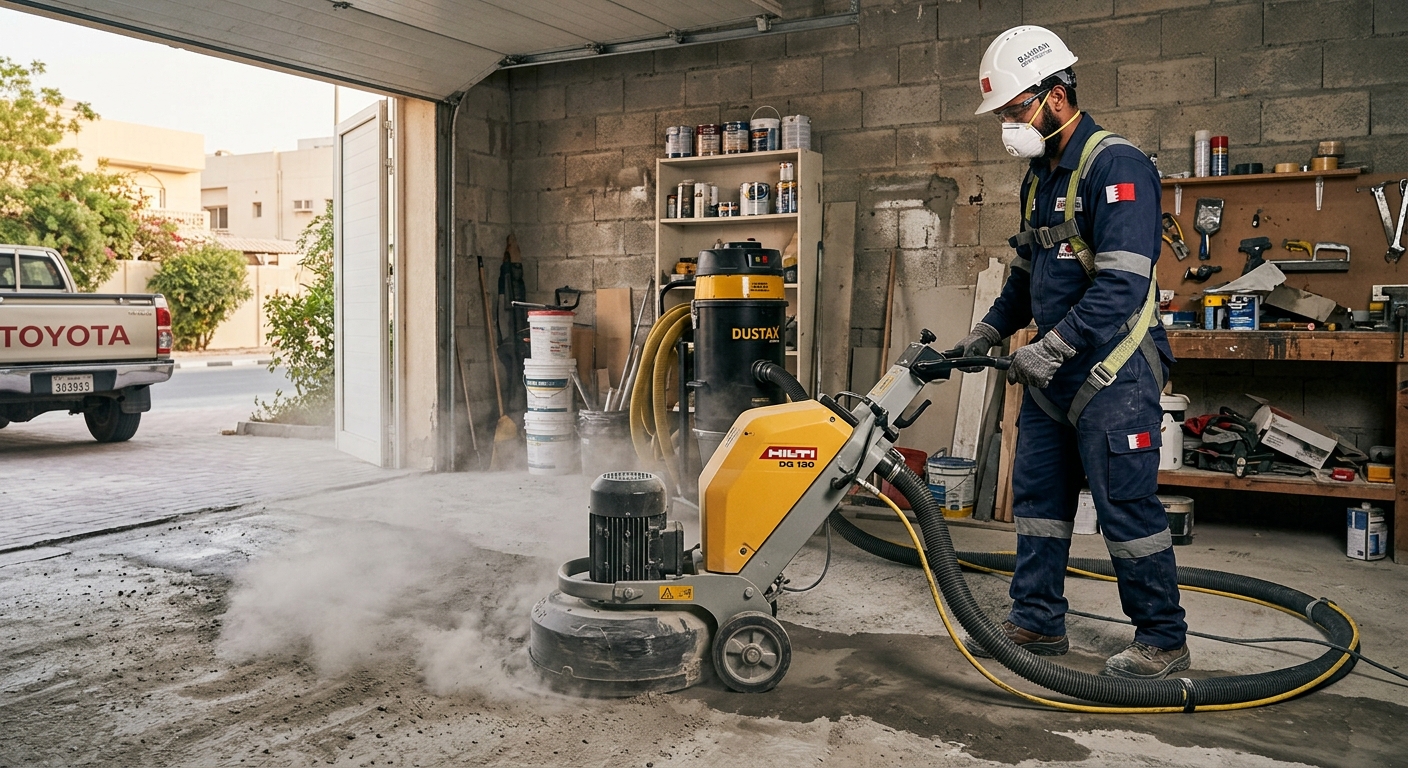
The most critical step in installing a concrete garage floor coating happens before a single drop of liquid touches the floor. Gulf concrete is typically machine-troweled, leaving a hard, dense, and smooth surface that resin cannot penetrate.
Many budget contractors attempt to prep the floor using an acid wash, which is completely ineffective on dense, oil-stained concrete. A professional installation requires heavy machinery equipped with 16-grit or 30-grit diamond tooling to physically grind off the top layer of the slab, exposing the open pores beneath. If your installer does not show up with a walk-behind diamond grinder and a heavy-duty vacuum system, stop the job immediately.
Assuming Standard Epoxy Survives Direct UV Exposure Without Chalking
Epoxy is an incredibly durable resin, but it has one fatal flaw: it is highly sensitive to ultraviolet (UV) light. When exposed to sunlight, the polymer chains in standard epoxy break down, causing the floor to turn a sickly yellow color and develop a chalky texture.
If your garage is an open carport or if you frequently leave the garage door open facing the afternoon sun, a pure epoxy topcoat will fail aesthetically within a year. The tradeoff here is cost: you must upgrade to a UV-stable polyaspartic or aliphatic polyurethane topcoat, which costs more but guarantees the floor will not yellow under Bahrain's intense sun.
Why This Matters (Practical Implications for Homeowners)
Understanding the chemistry and preparation requirements allows you to evaluate the true return on investment for your property. A proper coating system changes how you maintain your home and protects your underlying real estate asset.
Eliminating the Daily Cycle of Fine Concrete Dusting
A failing concrete surface generates a microscopic silica dust that acts like sandpaper on your home's interior floors and rapidly clogs your air conditioning filters.
By applying a concrete garage floor coating, you permanently encapsulate the slab. The immediate result is a drastic reduction in the amount of dust entering your home, lowering your indoor cleaning burden and extending the lifespan of your HVAC components.
Preventing BD 500+ Concrete Resurfacing Repairs from Chemical Etching
Bare concrete is highly reactive to the fluids leaking from vehicles. Engine oil, acidic air conditioning condensation, and battery acid will chemically etch into a bare slab, causing it to spall (crumble and pit) over time.
Once a slab is heavily pitted, patching it with standard cement won't work; the patches will pop out under vehicle weight. You will be forced to pay for a full structural resurfacing, which easily exceeds BD 500 for a standard two-car garage. A resin coating acts as a sacrificial barrier, allowing you to simply wipe up battery acid or oil weeks after a leak without any damage to the concrete.
Evaluating the BD 10 to BD 25 Per Square Meter Installation Value
When collecting quotes in Bahrain, you will see a massive price variance, typically ranging from BD 10 to BD 25 per square meter. It is critical to understand what you are giving up at the lower end of this spectrum.
A BD 10/sqm quote almost always means the contractor is skipping diamond grinding, using a cheap solvent-based epoxy, and applying only one or two thin coats. A BD 20 to BD 25/sqm system buys you mechanical diamond grinding, a moisture-mitigating primer, a thick 100% solids epoxy base coat, and a UV-stable polyaspartic topcoat. Choosing the cheaper option usually means paying twice—once for the cheap floor, and again a year later to grind it off and do it correctly.
Real-World Concrete Garage Floor Coating Applications
Different garage environments require entirely different chemical systems. You must match the resin technology to your specific usage and environmental exposure.
Polyaspartic Systems for High-Traffic Family Villas in Saar
Consider a semi-open carport in a busy villa in Saar, housing three heavy SUVs and exposed to blowing sand and afternoon sun. A standard epoxy system would yellow quickly and take 3 to 5 days to cure, displacing the family's vehicles onto the street.
In this scenario, a pure polyaspartic concrete garage floor coating is the correct choice. Polyaspartic resins are 100% UV stable (they will never yellow) and they cure incredibly fast. Installers can often prep and coat the floor in a single day, and the family can park their heavy SUVs on the surface just 24 hours later. The tradeoff is a higher upfront material cost and a requirement for a highly skilled installation crew, as the product hardens in minutes.
Chemical-Resistant Epoxy Builds for Automotive Enthusiast Garages in Riffa
Now consider a fully enclosed, climate-controlled garage in Riffa used by an automotive enthusiast who frequently works on classic cars. This floor faces heavy floor jacks, dropped tools, and prolonged exposure to brake fluid and harsh solvents. UV exposure is minimal.
Here, a high-build, 100% solids epoxy system makes sense. Epoxy cures slower, allowing it to build a much thicker, impact-resistant layer that absorbs the shock of dropped wrenches better than thin polyaspartics. The installer would finish this with a specialized chemical-resistant urethane topcoat to prevent brake fluid from eating into the resin. You trade the fast cure time and UV stability of polyaspartic for maximum thickness and chemical resistance.
Conclusion
The realization that a concrete garage floor coating is an active structural defense system rather than a passive layer of paint fundamentally changes how you approach garage maintenance. You are not just making the floor look glossy; you are permanently stopping concrete dusting, blocking destructive subsurface moisture, and preventing hot tires from tearing your slab apart.
The decision ultimately comes down to matching the right chemical resin to your specific exposure levels and budget context. You must decide whether your open, sun-facing carport requires a premium UV-stable polyaspartic, or if your enclosed workshop is better served by a thick, impact-resistant epoxy build.
Before committing to any system or contractor in Bahrain, the critical next step is to demand a calcium chloride moisture test on your bare concrete. Furthermore, you must verify in writing that the chosen installer will utilize mechanical diamond grinding to prepare the slab. Skipping either of these steps guarantees failure, regardless of how much you spend on the resin itself.