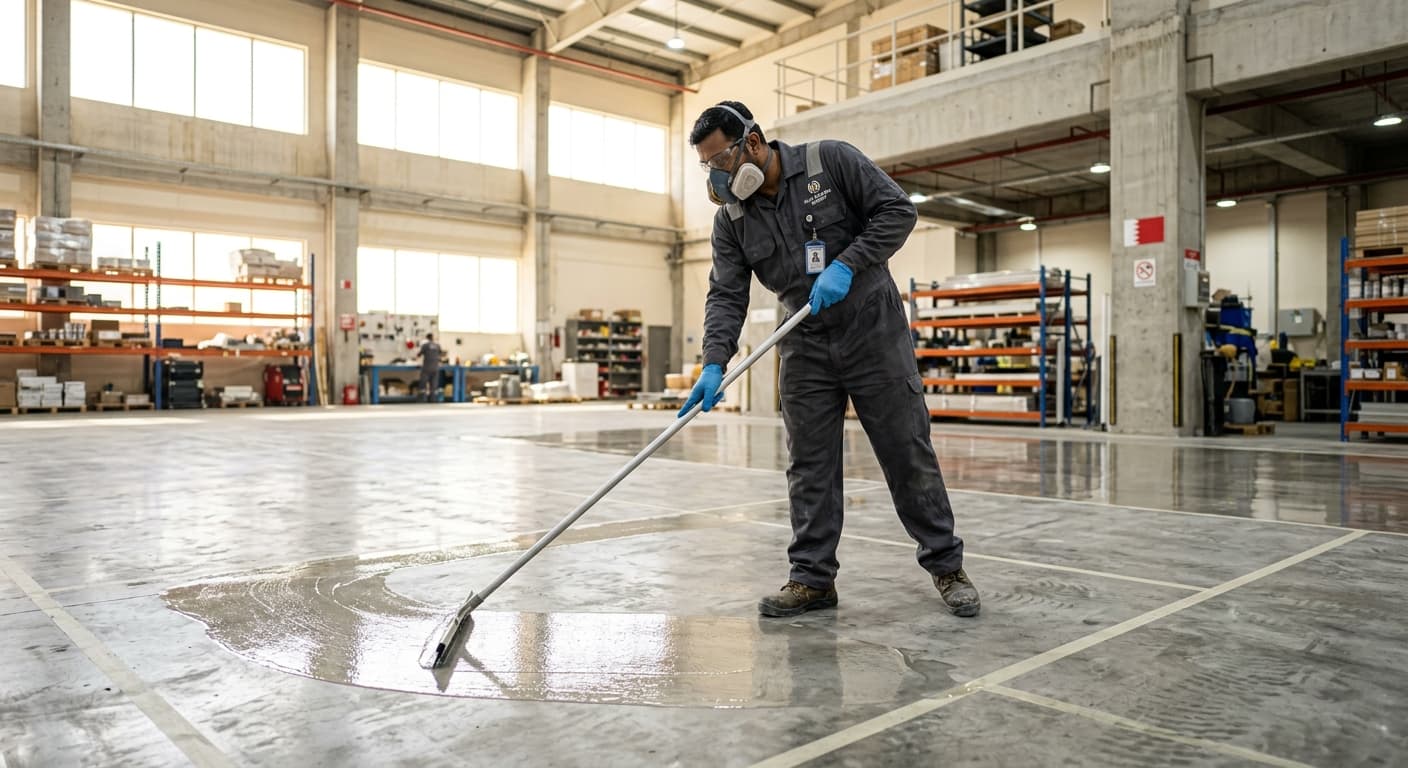
What Owners Must Know About Epoxy Bahrain
Property owners in the Gulf face a relentless combination of scorching summer temperatures, elevated coastal humidity, and high soil salinity that rapidly degrades standard concrete and tile flooring. Attempting to solve this with cheap DIY floor coatings or unspecialized labor results in blistering, peeling, and rapid yellowing within months.
The local market for epoxy bahrain is flooded with general maintenance crews applying residential-grade paints disguised as industrial coatings. True industrial-grade systems chemically bond with the concrete substrate, creating a monolithic surface that blocks moisture, resists chemical spills, and withstands heavy mechanical loads. This guide breaks down the chemical mechanisms behind epoxy failures in the Gulf, details realistic local pricing structures in Bahraini Dinars, and provides an exact framework for selecting specialized contractors who properly engineer their flooring systems.
How Bahrain's Extreme Climate Dictates Epoxy Selection
Epoxy is not a paint; it is a two-part thermosetting polymer. When the resin and hardener mix, a chemical reaction creates cross-linked polymer structures. Bahrain's climate actively interferes with this reaction, requiring specific chemical formulations to prevent premature failure.
Combating 90% Humidity During the 72-Hour Curing Process
In practice, high humidity during the August and September months ruins more epoxy floors than heavy traffic. When ambient moisture interacts with the curing agent before the floor fully hardens, it causes a chemical reaction known as "amine blush." This leaves a greasy, cloudy film on the surface that prevents any subsequent topcoats from adhering.
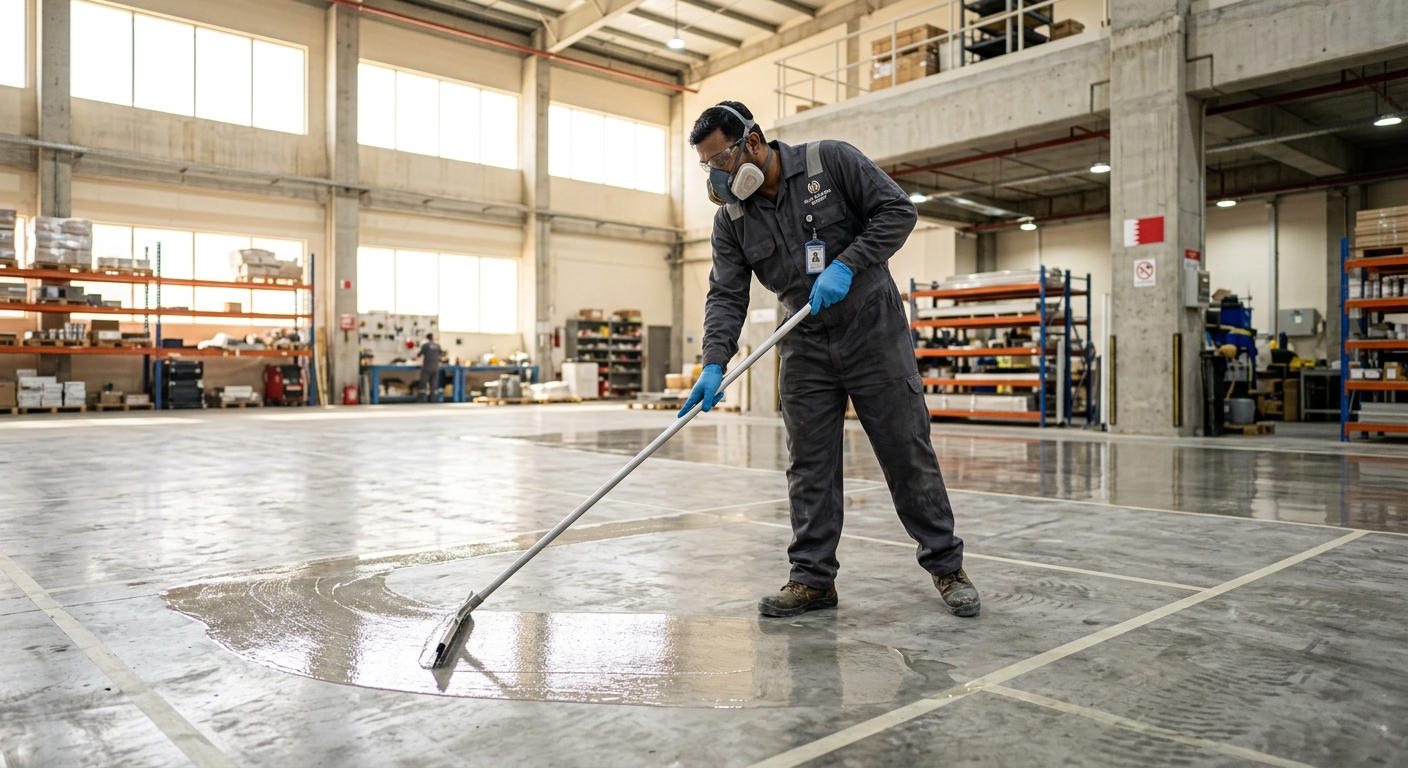
To prevent this, contractors must use moisture-tolerant epoxy primers engineered for high-humidity environments. If a contractor plans to pour a standard resin at 85% humidity without climate control, the installation will fail. The floor will look acceptable on day one, but the topcoat will begin peeling in large sheets within six months because the amine blush destroyed the chemical bond between layers.
Aliphatic Polyurethane Topcoats for UV Resistance in Sun-Exposed Areas
Standard bisphenol-A epoxy resins have zero natural UV resistance. When exposed to direct Bahrain sunlight—whether in an open garage in Saar or an outdoor commercial seating area—the UV radiation breaks down the polymer chains. The resulting floor turns a sickly yellow and develops a chalky residue on the surface within four weeks.
If your floor receives any natural sunlight, you must specify an aliphatic polyurethane topcoat over the epoxy base. Polyurethane provides exceptional UV stability and scratch resistance. What people underestimate is the tradeoff: polyurethane is applied much thinner than epoxy (typically 3 to 5 mils) and costs significantly more. You use epoxy for the structural build and impact resistance, and polyurethane strictly as the protective armor against the sun.
Thermal Shock Prevention for Facilities with Extreme AC Cycling
Industrial facilities and commercial kitchens often experience rapid temperature swings. A warehouse loading dock might bake at 45°C during the day, only to be hit with 20°C air conditioning when doors close. Concrete and standard epoxy expand and contract at different rates under these temperature changes.
When the temperature drops rapidly, the epoxy contracts faster than the concrete substrate beneath it. The resulting shear force literally tears the epoxy off the floor, a failure mode known as delamination. Facilities with high thermal cycling require flexible urethane cement systems or heavy-duty epoxy mortars rather than thin-coat roll-on epoxies. These thicker systems possess a coefficient of thermal expansion closer to that of the concrete itself, allowing the floor to move as a single unit.
Industrial vs. Residential Epoxy Systems in the Local Market
Matching the physical properties of the coating to the operational demands of the space is non-negotiable. Specifying a residential system for a commercial space wastes money, while over-engineering a villa garage drains your budget unnecessarily.
Heavy-Duty Mortar Systems for Sitra Industrial Warehouses
Warehouses operating heavy machinery and hard-wheeled forklifts will destroy standard roll-on epoxy bahrain systems in weeks. The point load from a fully loaded forklift turning sharply generates immense shear stress that chips thin coatings down to bare concrete.
Industrial zones in Sitra or Hidd require 100% solids epoxy mortar systems applied by trowel at a thickness of 6mm to 9mm. This involves mixing the epoxy resin with graded silica sand to create a synthetic concrete that boasts a compressive strength of over 10,000 PSI—nearly three times stronger than the concrete beneath it. What you give up is speed and cost; mortar systems require specialized trowel application and take days to install, making them the most expensive option on the market.
Self-Leveling Metallic Finishes for High-End Residential Villas
Metallic epoxies use metallic pigments suspended in a clear resin to create three-dimensional, marble-like effects popular in high-end villas and retail showrooms. The resin is poured thick and manipulated with squeegees, allowing the pigments to flow and settle during the cure.
A common surprise with metallic floors is their maintenance burden. While visually striking, the high-gloss finish highlights every dust particle and micro-scratch. If you install a metallic floor, you must mandate a sacrificial clear urethane topcoat. This topcoat takes the daily abuse and can be buffed and reapplied every few years without replacing the expensive metallic base layer.
Quartz-Broadcast Slip-Resistant Floors for Commercial Kitchens
Commercial kitchens require aggressive slip resistance to prevent workplace injuries from grease and water spills. Contractors achieve this by broadcasting colored quartz aggregate into a wet epoxy base coat until the floor is completely covered (a "full broadcast"), then sealing it with a clear topcoat.
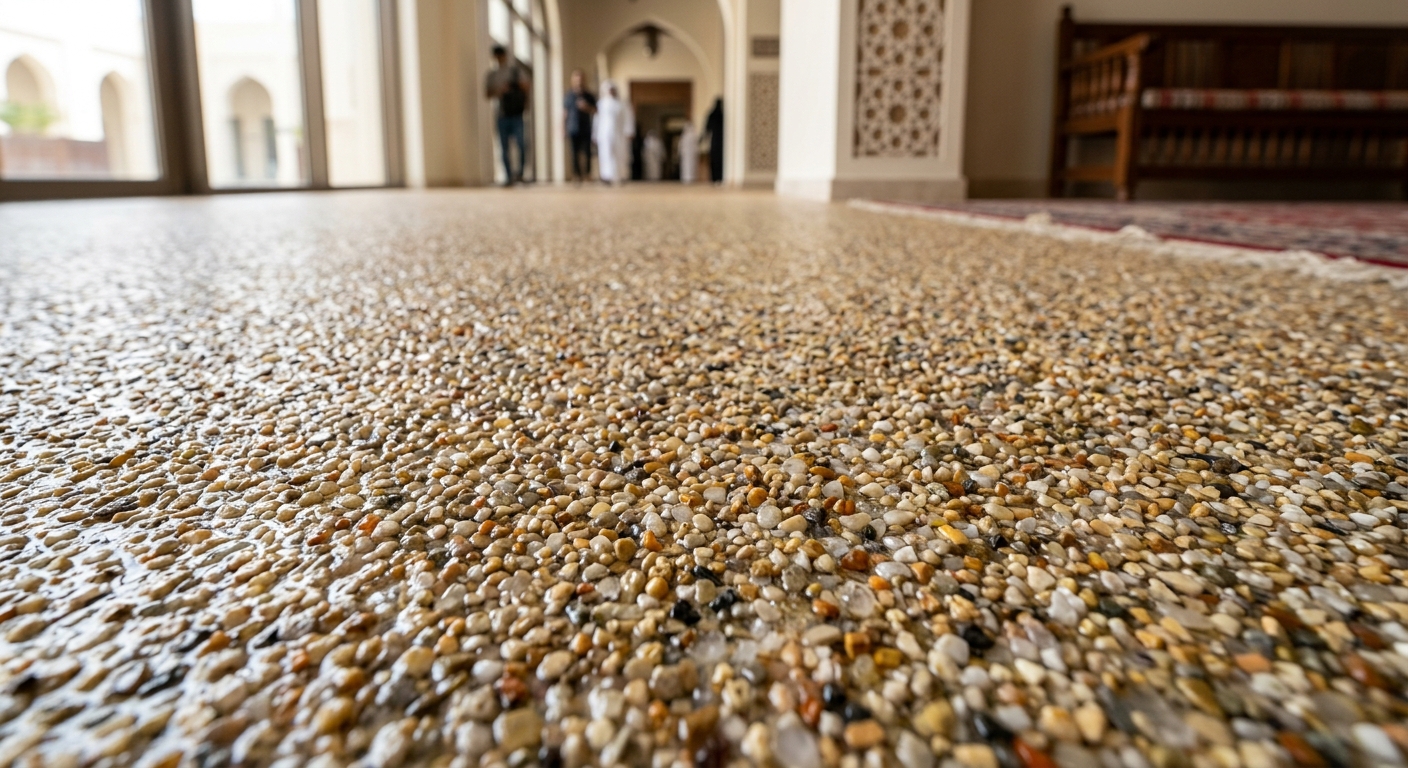
The tradeoff with high slip resistance is cleanability. An aggressively textured floor shreds traditional cotton mops and traps dirt. Facilities installing quartz-broadcast systems must upgrade their cleaning protocols to include deck brushes, degreasers, and wet vacuums. If the maintenance staff relies on standard mopping, the floor will look permanently dirty within a month.
Evaluating Installation Costs vs. Long-Term Durability
The pricing for epoxy bahrain varies wildly, leading property owners to make decisions based on false equivalencies. A quote for 4 BD per square meter and a quote for 12 BD per square meter are not offering the same product, even if both contractors call it "epoxy."
Breaking Down the 4 to 12 BD Per Square Meter Price Range
At 4 to 5 BD per square meter, you are purchasing a "paint and walk away" service. The contractor will likely sweep the floor, apply a single coat of water-based epoxy, and leave. This system has a lifespan of 12 to 18 months before hot-tire pickup (where hot car tires melt and peel the epoxy) or minor impacts destroy it.
At 10 to 12 BD per square meter, you are paying for structural longevity. This price includes mechanical surface preparation, a moisture-mitigating primer, a thick 100% solids base coat, broadcast media (flake or quartz), and a UV-stable topcoat. This multi-build system will easily last 10 to 15 years with basic maintenance. Choosing the cheaper option guarantees you will pay for a full grind and replacement within two years.
The Financial Impact of Diamond Grinding Surface Preparation
Epoxy does not stick to smooth concrete; it requires a porous surface with a specific "concrete surface profile" (CSP). The only acceptable method for achieving this in Bahrain is mechanical diamond grinding or shot blasting.
Budget contractors will offer to "acid etch" the floor to save money on grinding equipment. Acid etching fails spectacularly in Bahrain. The local concrete often contains high levels of salt and chlorides. Acid etching drives water into the slab, which later evaporates and pulls those salts to the surface (efflorescence), blowing the epoxy right off the floor. Never hire a contractor who relies on acid etching for surface preparation.
100% Solids Epoxy vs. Cheaper Water-Based Alternatives
Contractors often pad their margins by using water-based or solvent-based epoxies instead of 100% solids formulations. A product with 50% solids means half of what is poured onto the floor evaporates during the curing process. If the contractor applies a 10-mil wet coat, it shrinks to a 5-mil dry film.
100% solids epoxy contains no evaporating solvents. What you pour is what cures. A 10-mil wet application results in a 10-mil dry film. This creates a much denser, more impact-resistant barrier. Always demand the technical data sheets (TDS) for the proposed materials and verify the "volume solids" percentage is 100% for the base coats.
Vetting Bahrain Epoxy Contractors and Securing Guarantees
The barrier to entry for floor coating in Bahrain is dangerously low. Anyone with a bucket and a roller can claim to be an installer. Protecting your investment requires vetting contractors based on their technical protocols, not just their marketing photos.
Mandating Moisture Testing Before Contract Signing
Bahrain's high water table, particularly in reclaimed land areas like Amwaj or Diyar Al Muharraq, means concrete slabs constantly wick moisture from the ground. If the moisture vapor emission rate (MVER) exceeds the epoxy's tolerance, vapor pressure builds up beneath the coating and creates massive blisters that eventually pop.
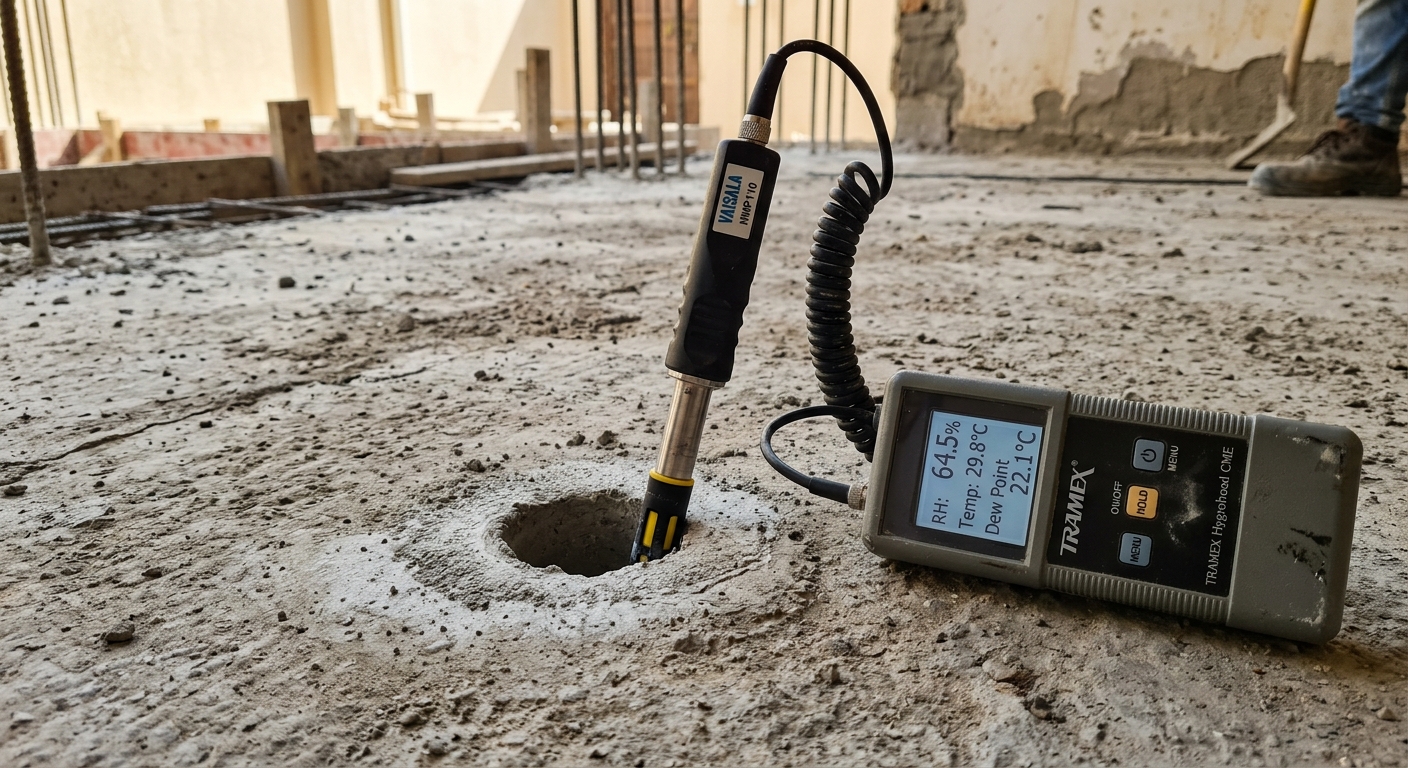
Skipping the moisture test guarantees a failed floor. Demand an ASTM F2170 relative humidity probe test before signing any contract. The contractor must drill into the slab and measure the internal moisture. If the relative humidity exceeds 75%, the contractor must include a specialized moisture vapor barrier primer in their quote. If a contractor tells you testing isn't necessary, immediately disqualify them.
Evaluating Contractor Portfolios Across Peak Summer Installations
Applying epoxy in Bahrain's peak summer requires specific technical knowledge. Epoxy cures via an exothermic (heat-generating) reaction. In a 40°C environment, the "pot life"—the time the contractor has to apply the mixed epoxy before it hardens in the bucket—drops from 40 minutes to less than 15 minutes.
Ask prospective contractors how they handle flash curing during summer installations. Competent installers will explain their use of slow-cure hardeners, smaller batch mixing, and climate control requirements. If they lack a specific protocol for temperature management, they will end up rolling partially cured, clumpy epoxy onto your floor, resulting in a severely compromised finish.
Structuring Milestone Payments Tied to Surface Prep and Final Cure
Never pay 100% upfront for an epoxy installation. The standard structure for professional epoxy bahrain projects should protect both parties while ensuring critical steps are not rushed.
Structure your payments as 30/40/30:
- 30% Mobilization: Paid upon material delivery and equipment arrival.
- 40% Surface Preparation: Paid only after inspecting the mechanically ground floor. You must verify the concrete is uniformly profiled (like rough sandpaper) before they apply the primer.
- 30% Final Cure: Paid 48 hours after the final topcoat is applied, allowing you to inspect for amine blush, bubbles, or uneven curing before handing over the final check.
A successful installation requires matching the chemical formulation to the precise environmental stressors of the facility and executing flawless concrete preparation. Skip the general maintenance crews and initiate your flooring project by scheduling a professional concrete moisture test with a specialized contractor to establish a baseline for your customized flooring system.