Anti Slip Kitchen Flooring: What Actually Matters
The number one mistake homeowners make when buying anti slip kitchen flooring is choosing a tile based purely on how rough it feels in the showroom. Running your dry hand over a textured surface tells you absolutely nothing about how it performs when covered in cooking oil, water, and tracked-in sand from outside.
Most flooring guides overcomplicate the decision by debating material types—like luxury vinyl versus ceramic—when the only things that dictate safety are the certified slip resistance rating, the cleanability of the texture, and its impact durability. A floor that prevents slips but traps rotting food particles is a failed installation.
This guide provides a strict framework for evaluating kitchen floors in Bahrain. You will learn how to prioritize objective friction scores, balance that grip against how easily your mop can glide over it, and ensure the material survives the heavy traffic and specific climate challenges of a busy regional kitchen.
Factor 1: Certified Slip Resistance (The R-Rating and PTV)
Objective friction metrics separate true anti-slip flooring from hazardous imitations. Never trust a salesperson's verbal assurance that a tile is "slip-resistant."
Why R11 is the Absolute Minimum for Residential Kitchens
The "R-Rating" (Ramp Test) measures slip resistance on a scale from R9 to R13. Manufacturers determine this by putting a subject in work boots on an oil-lubricated ramp covered in the flooring material, slowly tilting it until the person slips.
R9 and R10 tiles will fail in a kitchen environment. They lack the surface displacement volume required to push liquids out from under your shoe, causing an immediate hydroplaning effect when wet.
For a residential kitchen, R11 is the absolute minimum requirement. At R11, the flooring has enough microscopic peaks and valleys to break the surface tension of water and light grease, allowing your shoe to make contact with the solid material beneath.
Translating PTV Scores (Aim for 36+ in Wet Conditions)
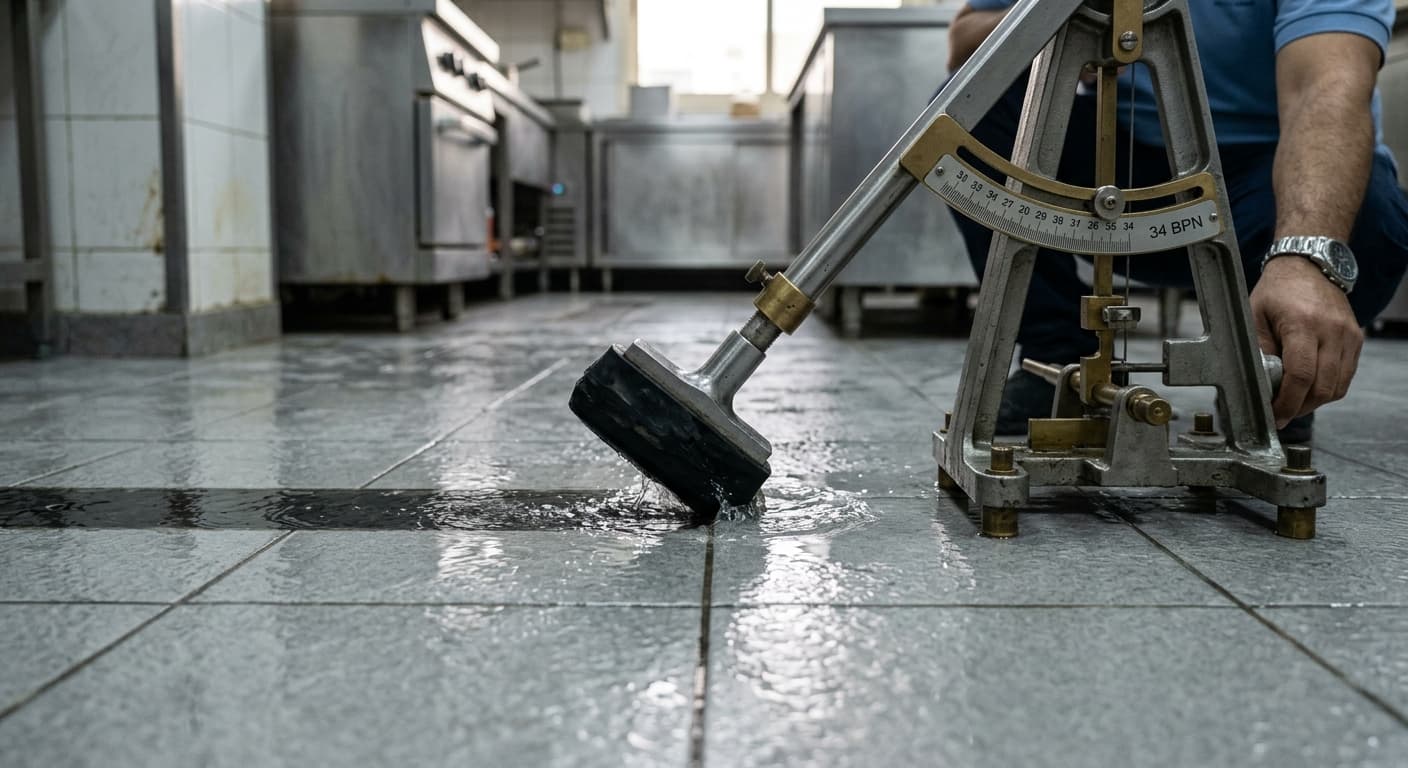
While the R-rating tests with oil and boots, the Pendulum Test Value (PTV) simulates a bare foot or rubber sole striking a wet floor. A mechanical pendulum swings a rubber heel across the tile, measuring the exact frictional resistance.
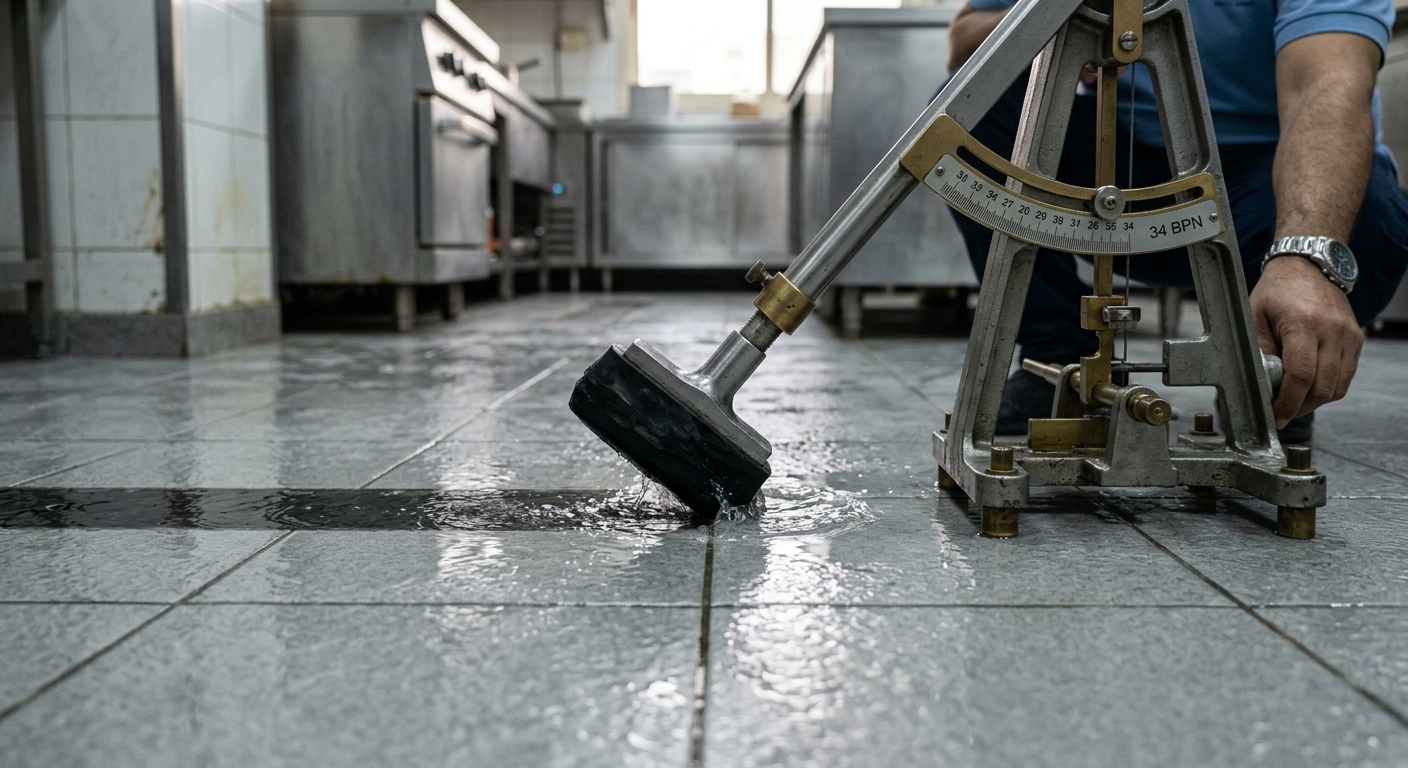
If a supplier cannot provide a PTV score, walk away. You must demand a PTV score of 36 or higher in wet conditions. Anything below 36 means there is a higher than 1-in-1,000 chance of slipping, which is unacceptable in an active cooking space.
The Oil vs. Water Friction Difference in Heavy-Cooking Homes
Water and cooking oil behave entirely differently on flooring. Water only requires micro-roughness to disperse, but oil requires macroscopic texture—visible grooves or raised aggregates—to prevent a slip.
In kitchens where heavy frying is common, airborne grease eventually settles on the floor. If you choose a tile optimized only for water (like an R10 bathroom tile), that microscopic texture quickly fills with polymerized grease. Within three months, the floor becomes an ice rink, regardless of how often you mop it.
Factor 2: The Dust-Trap Dilemma and Cleanability
You cannot maximize grip without sacrificing cleanability. The rougher the floor, the harder it is to maintain.
How Fine Bahraini Sand Defeats Deep-Textured Tiles
Bahrain's environment introduces a specific failure mode: ultra-fine sand blown in by Shamal winds. When this micro-dust mixes with ambient kitchen humidity and settled cooking grease, it forms a concrete-like grime.
If you choose an R12 or R13 tile with deep, aggressive texturing, this sand-grease mixture embeds itself into the valleys of the tile. Standard string mops will simply glide over these valleys, leaving the dirt behind. Over a year, this trapped dirt permanently discolors the floor and completely neutralizes the anti-slip properties you paid for.
Grout Lines: Sizing Limitations to Prevent Grease Build-Up
Grout is inherently porous and sits slightly lower than the tile surface, creating a natural trench for dirty mop water and grease to pool. Standard 4mm or 5mm grout lines in a kitchen are a guaranteed hygiene failure.
Limit grout lines to a maximum of 2mm. To achieve this, you must buy "rectified" tiles—tiles cut with a laser after firing to ensure perfectly straight edges.
Tradeoffs of 2mm grout lines:
- Upside: Drastically reduces the surface area where grease can accumulate.
- Downside: Requires a highly skilled installer and a perfectly level concrete subfloor.
- Requirement: You must use epoxy grout, not standard cementitious grout. Epoxy is waterproof and blocks grease absorption, whereas cement grout acts like a sponge.
The Showroom Wet-Mop Test: Validating Glide Before Buying
Never buy anti slip kitchen flooring without testing its cleanability. The texture must grip a shoe, but it should not shred a mop.
Bring a standard microfiber mop pad to the showroom. Wet it, place it on the sample tile, and apply downward pressure while pushing. If the mop stutters, catches, or leaves lint behind on the tile's surface, the texture is too aggressive. You will spend hours scrubbing this floor on your hands and knees because standard mopping will fail.
Factor 3: Impact Durability and Moisture Resistance
Kitchen floors must survive dropped cast iron, vibrating heavy appliances, and invisible moisture threats.
Porcelain vs. Ceramic for Surviving Cast Iron Drops
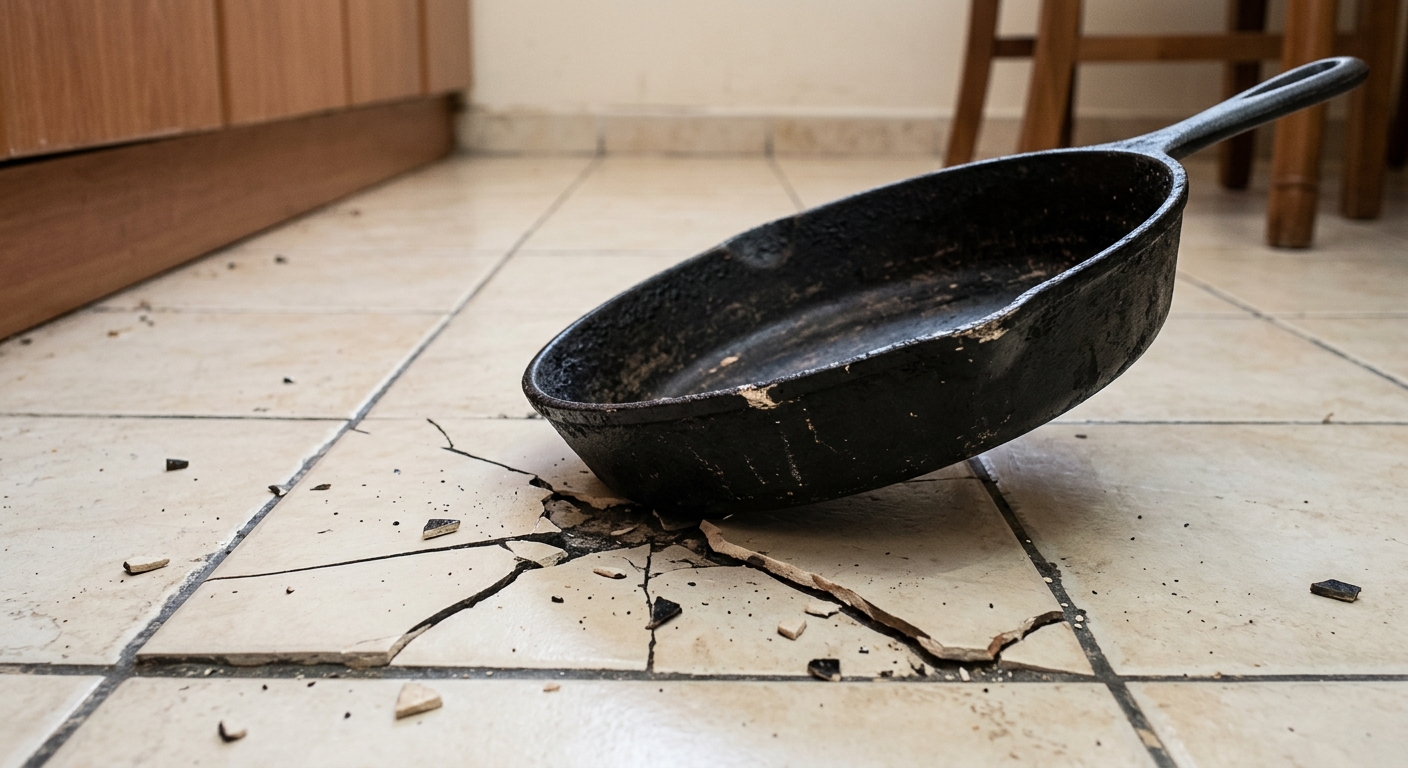
Do not install standard ceramic tiles in a kitchen. Ceramic is fired at lower temperatures, leaving it relatively soft and porous underneath its top glaze. When you drop a heavy pot on a ceramic tile, the impact punches straight through the glaze, exposing the clay body and creating a permanent crater.
You must specify through-body porcelain. Porcelain is fired at much higher temperatures, making it incredibly dense. "Through-body" means the color and material are consistent all the way through the tile. If a heavy impact does manage to chip a through-body porcelain tile, the damage is nearly invisible because there is no contrasting clay layer underneath.
Preventing Lifting from Extreme AC Condensation and Humidity
In Bahrain, heavy air conditioning use creates a hidden thermal dynamic. The concrete floor slab gets cold, while the ambient air (especially when outside doors are opened) is hot and humid. This causes condensation to form underneath the flooring if the subfloor wasn't properly sealed.
If you use a porous ceramic tile (which absorbs up to 4% water), this sub-surface moisture travels upward, degrading the tile adhesive. Within two years, the tiles will sound hollow when tapped and eventually pop loose. Porcelain has a water absorption rate of less than 0.5%, completely blocking this moisture transfer and protecting the adhesive bond.
Why Matte Finishes Degrade Faster Than Fired Anti-Slip Glazes
A standard "matte" tile is not an anti-slip tile. Matte simply means the manufacturer skipped the final polishing phase.
True anti-slip tiles feature a specialized glaze containing microscopic abrasive particles (like aluminum oxide) fired into the surface at 1,200°C. If you buy a cheap matte tile, the friction comes entirely from the slightly rough clay. The daily abrasion of walking on fine sand will polish a cheap matte tile smooth within 18 months, destroying any grip it originally had. Fired abrasive glazes maintain their R11 rating for decades.
What Not to Waste Money On: Overhyped Features
Salespeople will attempt to upsell you on products that solve problems you don't have, or offer shortcuts that fail in practice.
After-Market Anti-Slip Chemical Coatings on Cheap Tiles
Suppliers often try to sell cheap, glossy tiles by offering to spray an "anti-slip chemical treatment" over them after installation. Reject this immediately.
These treatments are mild acids that microscopically etch the top layer of the tile.
- Why it fails: The etching process creates microscopic pores that trap dirt instantly.
- The consequence: The floor will look permanently dirty within a week. Furthermore, the chemical coating wears off in high-traffic areas (like in front of the stove or sink) in less than six months, leaving you with dangerous, slippery patches.
Commercial-Grade R13 Flooring for Residential Villas
Do not buy R13 rated flooring for a home kitchen. R13 tiles are designed for commercial abattoirs and industrial fry-kitchens where workers wear heavy rubber boots and the floors are cleaned daily with high-pressure power washers.
In a residential setting, an R13 floor will destroy your socks, shred your mops, and trap every single pet hair and dust particle that enters the room. Stick to R11 for the optimal balance of safety and domestic maintenance.
Acoustic Underlayments on Concrete Ground Floors
In Bahrain, most villa ground floors are solid concrete slabs. Salespeople frequently push "acoustic" or "cushioned" underlayments, claiming they make standing in the kitchen more comfortable.
Never put a soft underlayment beneath a rigid tile on a concrete slab. The underlayment introduces microscopic vertical flex when you walk on it. Because porcelain and epoxy grout have zero flexibility, this movement will cause the grout lines to crack and crumble within months. If you want comfort while cooking, buy a high-quality anti-fatigue mat for the area directly in front of the stove.
Budget Guide: How Much Should You Spend in Bahrain?
Prices in Bahrain vary wildly based on origin (Spanish/Italian vs. Indian/Chinese) and true performance metrics. Here is exactly what you get at different price points.
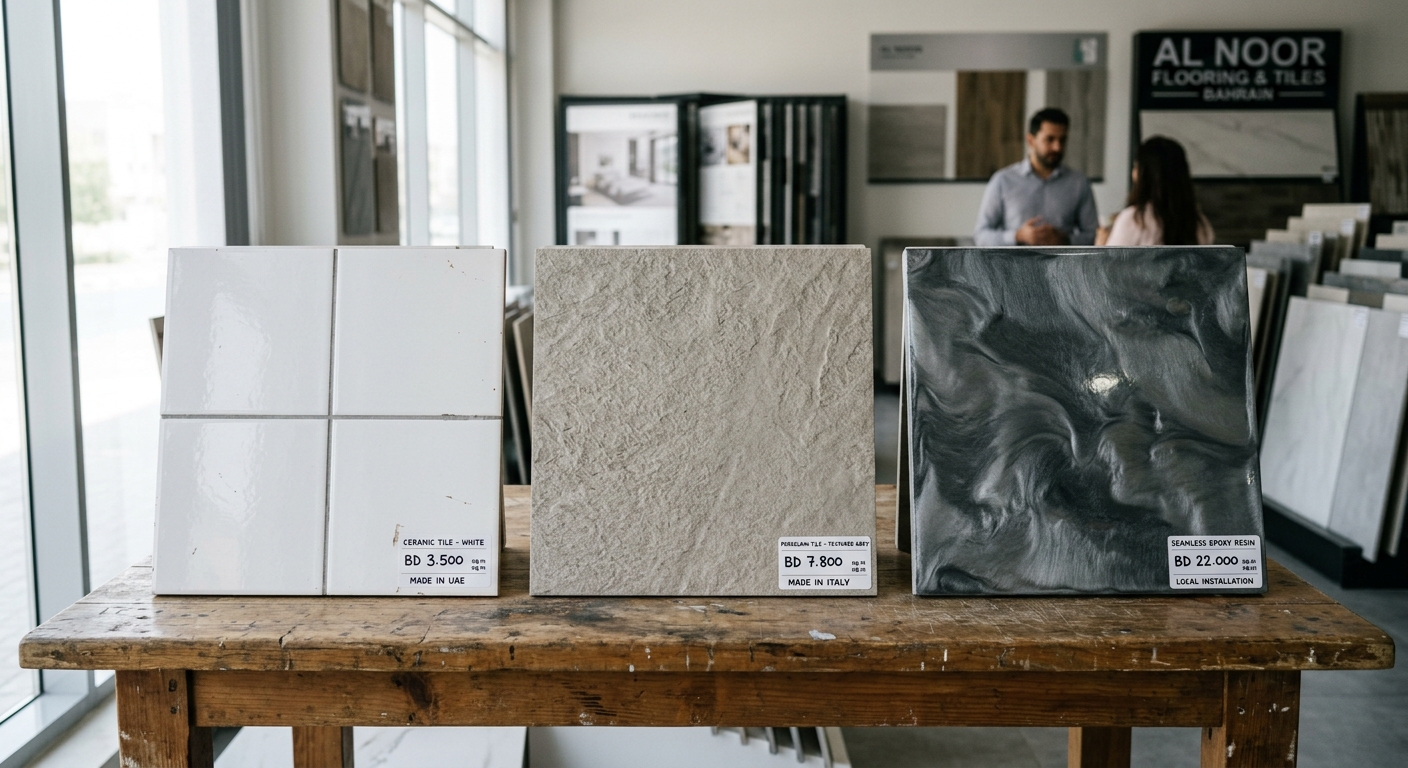
Entry Level (BD 3-5 per sqm): Basic Textured Ceramic
At this price, you are buying standard ceramic tiles with a stamped texture.
- What you get: A floor that looks acceptable but has a water absorption rate above 3%.
- The reality: The texture is usually molded, not created with abrasive glazes. It will feel rough to the touch but will fail the PTV 36 wet test. These tiles will chip easily if you drop utensils and are highly susceptible to popping loose from AC condensation. Avoid this tier for primary kitchens.
Mid-Range (BD 6-12 per sqm): High-Friction Through-Body Porcelain
This is the target zone for 90% of residential kitchens.
- What you get: Authentic through-body porcelain, laser-rectified edges for 2mm grout lines, and factory-certified R11 glazes.
- The reality: Tiles imported from Spain or Italy at the higher end of this bracket (BD 10-12) will have superior pattern variation and more durable abrasive glazes. At this level, the floor will survive dropped cast iron and provide genuine slip resistance that lasts decades.
Premium (BD 15+ per sqm): Luxury Seamless Epoxy or Treated Stone
At the high end, you move away from traditional tiles into seamless applications or specialized stone.
- What you get: Poured quartz-aggregate epoxy flooring or flamed granite.
- The reality: Seamless epoxy provides massive advantages because it eliminates grout lines entirely, making it the most hygienic and easy-to-clean anti-slip surface available. However, it requires a highly specialized installation crew. Flamed granite offers incredible durability and natural R11+ grip, but requires annual chemical sealing to prevent oil stains.
Red Flags and Scams to Avoid in Local Showrooms
The flooring market is largely unregulated regarding safety claims. Protect yourself by watching for these specific warning signs.
The 'Matte Equals Anti-Slip' Sales Lie
If you ask for anti slip kitchen flooring and the salesperson simply points you to the "matte finish" section, leave the store. A matte finish simply lacks a high-gloss polish; it does not inherently possess the displacement volume or abrasive particles required to prevent hydroplaning on wet surfaces.
Missing Independent Lab Certifications (DIN 51130 Standard)
A tile is only anti-slip if a laboratory says it is. Ask to see the manufacturer's specification sheet. You are looking specifically for the DIN 51130 standard (the German testing standard universally used for R-ratings).
If the spec sheet does not explicitly list DIN 51130 and an R-rating of at least R11, the tile is not rated for wet-area safety. Do not accept internal company ratings or vague terms like "high grip."
Contractors Pushing High-Gloss Tiles with 'Invisible' Grip Sprays
Some contractors will push you toward large-format, high-gloss marble or porcelain tiles because they look impressive in a portfolio. When you bring up slip hazards, they will promise to apply an "invisible" anti-slip spray.
As detailed earlier, this is a scam that compromises the tile's factory seal. The contractor gets a beautiful photo for their Instagram, and six months later, you are left with a dangerous, permanently stained floor.
Conclusion
To finalize your decision on anti slip kitchen flooring, follow this strict checklist to ensure you don't waste money on a hazardous or unmaintainable surface.
First, demand to see the manufacturer's specification sheet and reject anything below an R11 rating for kitchens. Second, verify the PTV score is 36 or higher for wet conditions. Third, ensure the material is through-body porcelain with a water absorption rate below 0.5% to survive drops and subfloor condensation.
Balance the texture against your cleaning routine by insisting on laser-rectified edges that allow for 2mm epoxy grout lines.
Finally, validate your choice before purchasing. Take a sample tile home, pour a mix of water and cooking oil on it, and press a rubber-soled shoe against the surface at a 45-degree angle. Push hard. If the shoe slips, reject the tile immediately. Your kitchen floor is a functional workspace first; prioritize safety and durability over showroom aesthetics.