What Is a Garage Flake Floor? (And Why It Resists Heat)
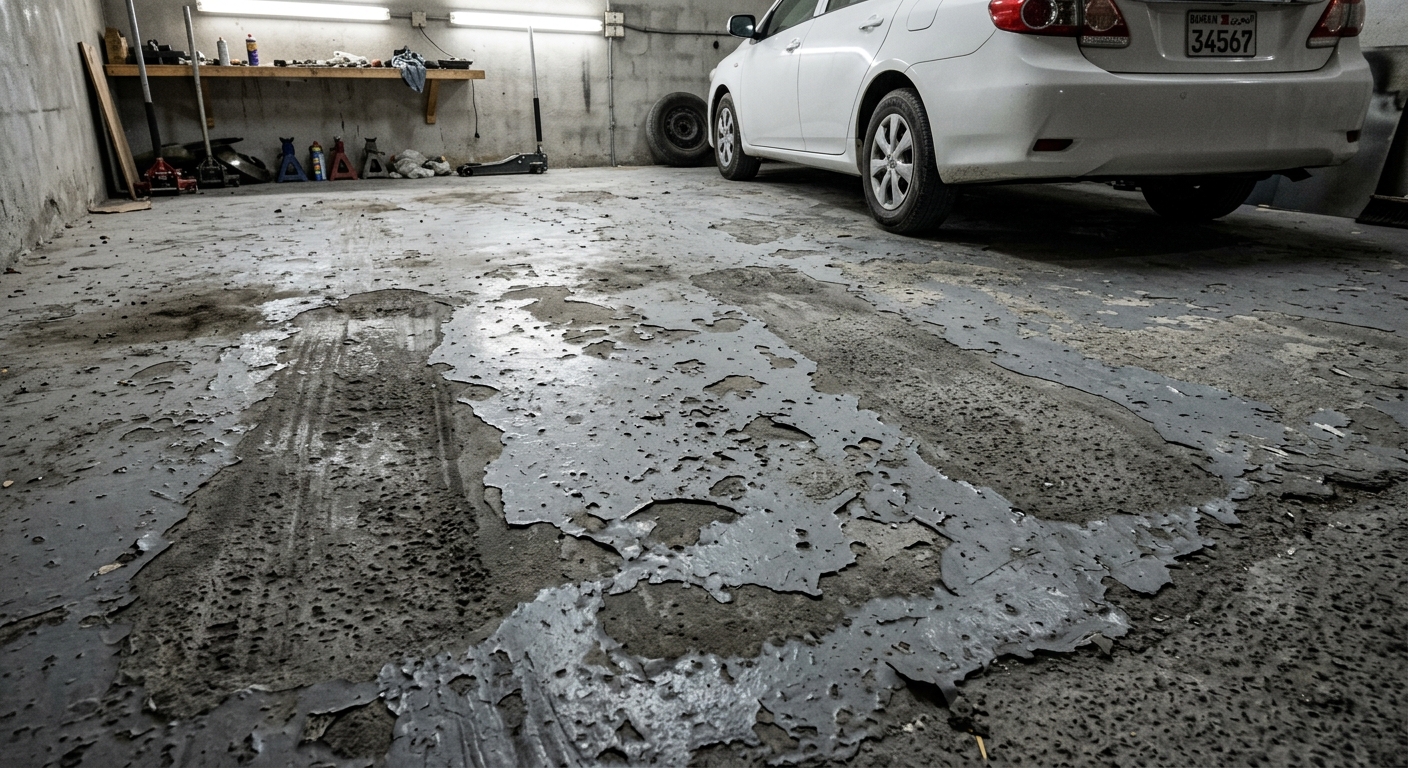
Imagine pulling your Nissan Patrol into your garage in Manama after a long drive in July. Your tires have been baking on asphalt and are scorching hot, and as you back out the next morning, patches of your garage floor paint peel right off, stuck to the rubber.
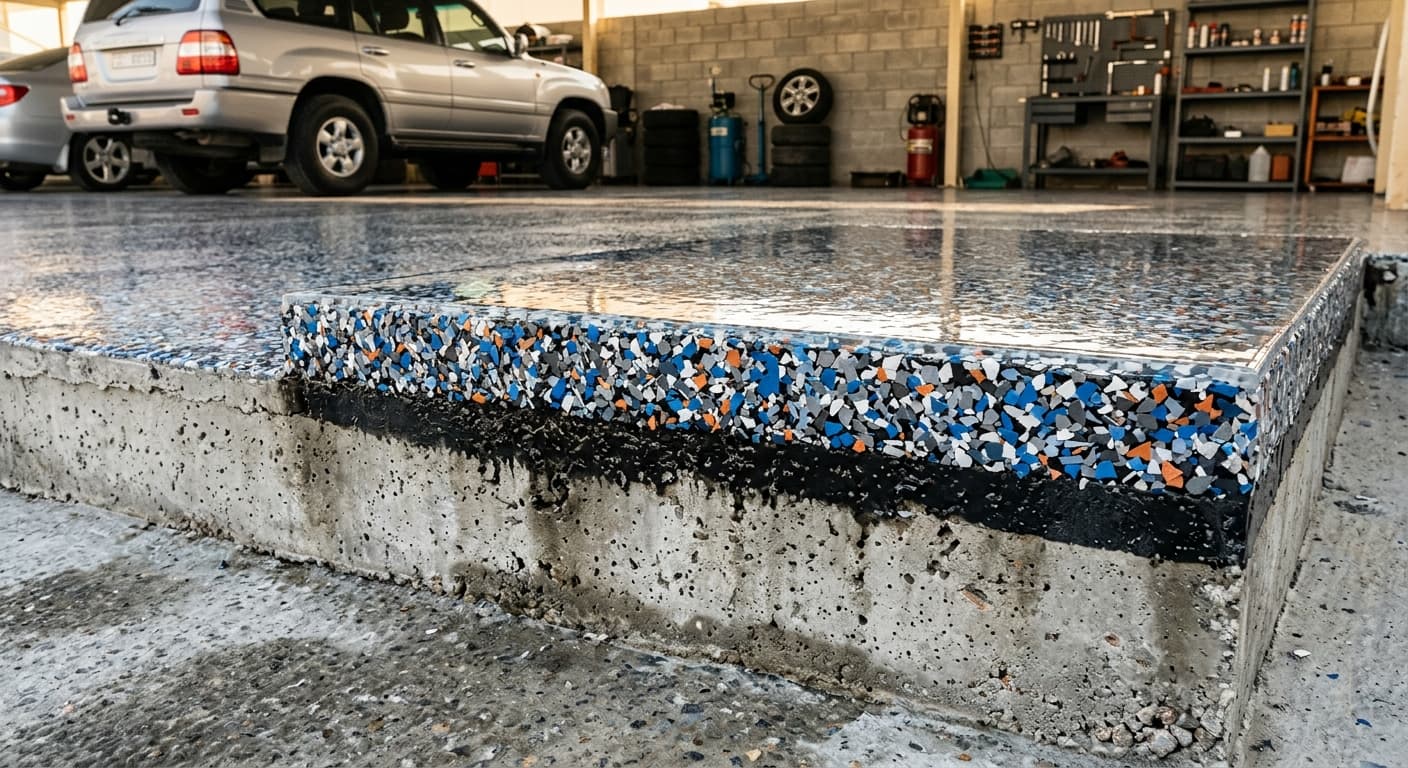
This frustrating phenomenon, known as hot tire pickup, drives homeowners to search for a permanent solution rather than repainting every year. A garage flake floor is a multi-layered chemical coating system that embeds vinyl chips between a colored base and a clear protective shield to create a seamless, heat-deflecting surface.
People research this option when deciding whether to waste another BD 30 on standard acrylic paint or invest in a permanent structural upgrade. Understanding how the chemical bond and structural flakes work together reveals exactly why this specific flooring survives 50°C summers while traditional alternatives blister and fail.
What a Garage Flake Floor Actually Means
Contractors often market these systems as "epoxy floors," but that label misses the actual mechanics of how the floor survives daily abuse. You are not buying a layer of paint; you are installing a composite polymer slab directly over your existing concrete.
The Three-Part Chemical Armor System
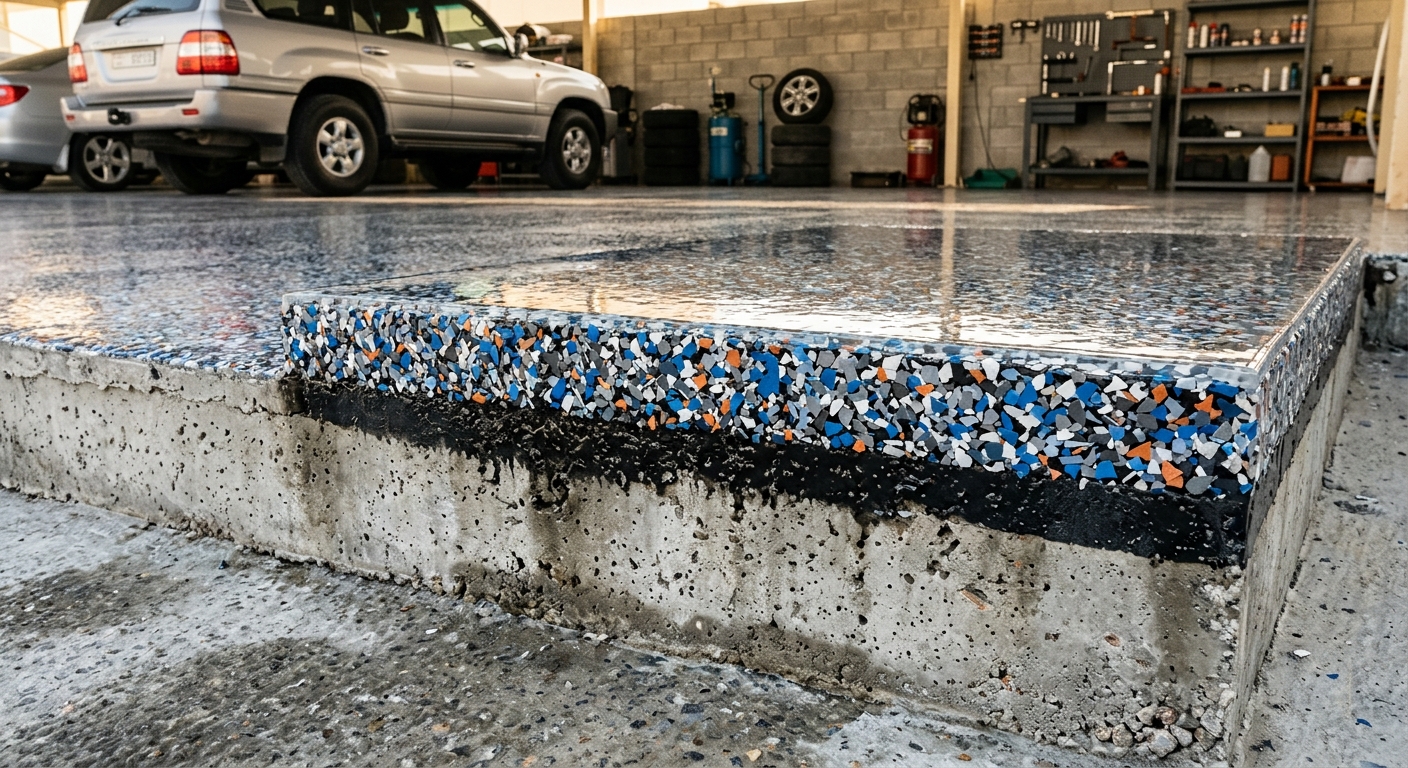
A true garage flake floor requires three distinct chemical layers to function correctly, and skipping any of them guarantees premature failure.
First, a moisture-mitigating epoxy primer wicks deep into the open pores of mechanically ground concrete, creating a structural anchor rather than just sitting on the surface. Second, a dense layer of vinyl chips acts as the bridging material. Finally, a clear polyaspartic or polyurethane topcoat seals the system, providing chemical and scratch resistance.
Vinyl Chips as Structural Reinforcement (Not Just Decor)
The biggest mistake homeowners make is assuming the colored flakes are merely decorative confetti thrown in for aesthetics. In reality, these vinyl chips serve a critical structural purpose: they distribute localized weight and impact across a wider surface area.
When you drop a heavy wrench or park a three-ton SUV on the floor, the microscopic gaps between the flakes compress slightly to absorb the shock. Without this dense matrix of vinyl flakes, point-impacts would transfer directly to the rigid epoxy base layer, causing it to shatter or chip away from the concrete.
How a Garage Flake Floor Works to Deflect Heat
Bahrain's climate destroys conventional flooring materials through a combination of extreme ambient heat and violent temperature swings. To make a smart choice, you must understand the physics of how different chemicals react to thermal stress.
Preventing Hot Tire Pickup at 50°C Ambient Temperatures
When you drive on Bahrain's highways in August, the friction and ambient heat push your tire's internal temperature well above 80°C. When you park, that intense heat transfers directly into the floor beneath the tires.
Standard hardware store floor paints are thermoplastic, meaning they soften and become sticky at around 60°C. As the hot tire cools overnight, the rubber contracts and literally grabs the softened paint, ripping it off the concrete when you reverse the next day. A professional garage flake floor utilizes thermosetting polymers, which cure through a permanent chemical reaction and remain completely structurally stable up to 120°C, making hot tire pickup physically impossible.
The Role of Polyaspartic Topcoats in Thermal Shock Resistance
Many homeowners opt for cheap, 100% epoxy systems, only to watch the coating turn yellow and crack near the garage door within six months. Standard epoxy is notoriously rigid and highly sensitive to ultraviolet light.
This is where polyaspartic topcoats become mandatory in the Gulf. Polyaspartic technology flexes microscopically to accommodate the rapid expansion and contraction of the concrete slab when a hot garage is suddenly washed with cold water.
Tradeoff: Polyaspartic materials cure extremely fast (often in under an hour), meaning they require highly skilled, rapid application by a multi-person crew. You give up the ability to DIY this project in exchange for a floor that won't shatter under thermal shock or yellow under the Bahrain sun.
Common Misconceptions About Garage Flake Floors
The flooring industry is full of misleading terminology that tricks property owners into buying inadequate systems. Knowing the mechanical differences between products prevents expensive redo jobs.
Confusing DIY Hardware Store Kits with Professional Resin Systems
Homeowners often compare a BD 50 DIY kit from a local hardware store with a BD 600 quote from a professional installer, assuming they are the same material. They are entirely different chemical compounds.
DIY kits are water-based or solvent-based epoxies, containing up to 50% liquids that must evaporate for the floor to dry. As they evaporate, the coating shrinks down to a microscopic 3 mils thick (the thickness of a sheet of paper). Professional systems use "100% solids" resins that cure chemically without evaporating, leaving a dense, impact-resistant layer that is 15 to 20 mils thick.
Assuming 100% Flake Coverage is Purely Aesthetic Rather Than Functional
Installers will often offer a "partial broadcast" option where flakes are scattered lightly like Dalmation spots to save money. This is a critical structural compromise.
A "full broadcast" system means flakes are thrown into the wet base coat until the floor physically cannot hold any more (known as broadcasting to rejection).
- When partial broadcast makes sense: Light-duty storage rooms where foot traffic is minimal and budgets are extremely tight.
- When partial broadcast fails: Garages with vehicle traffic. Exposed epoxy base coats will quickly scratch from sand abrasion and degrade from UV exposure.
- The tradeoff: A full broadcast system costs roughly 25% to 30% more in materials, but it doubles the lifespan of the garage flake floor because your tires and tools only ever touch the protective polyaspartic topcoat and the vinyl matrix, never the vulnerable base resin.
Why This Matters for Bahrain Homeowners (Practical Implications)
Translating the chemistry of these floors into daily practicalities helps justify the upfront capital required for a proper installation.
Evaluating the BD 400 to BD 800 Investment vs. Annual Repainting Costs
A high-quality, professionally installed garage flake floor in Bahrain typically costs between BD 400 and BD 800 for a standard two-car garage, depending on the concrete's condition.
While paying a local painter BD 60 to roll on a fresh coat of acrylic seems cheaper today, you must factor in the hidden costs. Emptying the garage, breathing paint fumes for three days, and dealing with peeling paint every single year quickly outpaces the cost of a one-time permanent installation. Over a 10-year horizon, the flake system is strictly cheaper and requires zero maintenance beyond occasional sweeping.
Combating Sand Abrasion and 90% Humidity in Gulf Climates
During Shamal winds, fine sand blows under garage doors and settles on the slab. When you turn your tires on this sand, it acts like 80-grit sandpaper grinding into the surface. The polyaspartic topcoat on a proper flake floor is highly abrasion-resistant, preventing this daily grinding from dulling or scratching the finish.
More importantly, Bahrain's severe August humidity creates a hidden failure mode: moisture vapor transmission (MVT). When the ground is saturated and the air is humid, water vapor pushes up through the porous concrete slab. If your contractor does not mechanically grind the floor to open the pores and apply a moisture-mitigating primer, this hydrostatic pressure will literally blow the coating off the floor from underneath in large, solid sheets.
Examples in Practice: Flake Floors Across Bahrain
Looking at how these systems perform in specific local environments reveals what to expect after the installers leave.
Residential Villas in Saar: Supporting 3-Ton SUVs Without Indentation
In neighborhoods like Saar and Janabiya, it is common for households to park heavy vehicles like Toyota Land Cruisers or GMC Yukons inside enclosed garages. These vehicles concentrate over 3,000 kilograms of weight onto four small tire contact patches.
On bare concrete, this weight slowly grinds dust into the air. On cheap epoxy, the constant pressure combined with engine heat causes micro-cracking. A full-broadcast garage flake floor utilizes the multi-layered vinyl chips to act as a load-distribution mat, entirely preventing tire indentations or surface cracking even after years of parking in the exact same spot.
Auto Workshops in Salmabad: Resisting Engine Oil and Coolant Spills
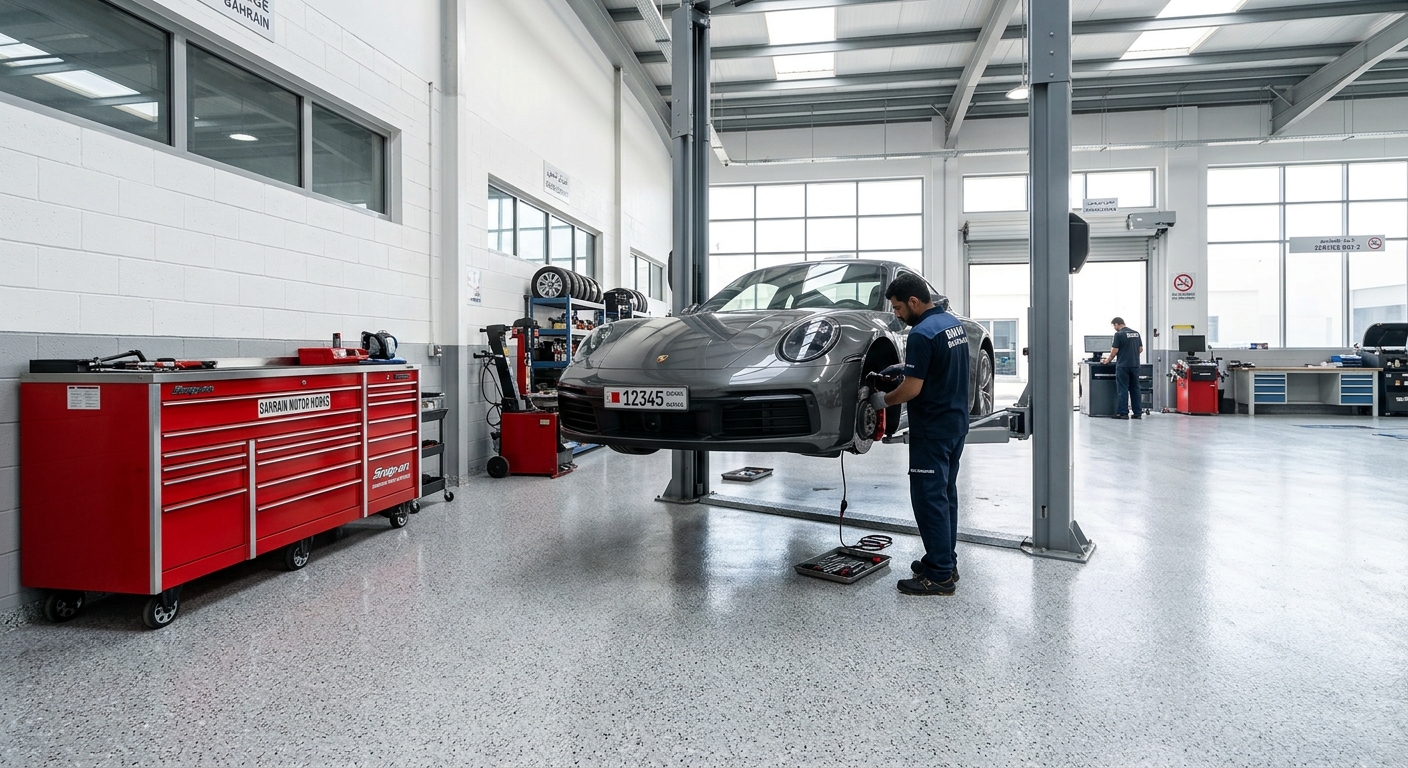
In commercial automotive settings or home DIY garages, chemical resistance is the primary requirement. Bare concrete acts like a rigid sponge; if you spill used motor oil or synthetic brake fluid, it permanently stains the slab within minutes.
Because the polyaspartic topcoat of a flake system is completely non-porous and chemically inert, harsh automotive fluids cannot penetrate the surface. If you spill corrosive engine coolant or hydraulic fluid, it simply beads up on top of the clear coat. You can wipe it away with a shop rag hours later with zero discoloration or degradation of the floor.
Summary
The real breakthrough in understanding a garage flake floor is realizing that the 'flakes' act as micro-structural heat sinks and impact distributors, rather than just colorful decorations. For property owners in Bahrain dealing with extreme summer heat, blowing sand, and heavy vehicles, upgrading to a full-broadcast flake system with a UV-stable polyaspartic topcoat is the only mechanically sound way to eliminate hot tire pickup.
Before committing to any contractor, demand that they test your current concrete slab for moisture vapor transmission. High baseline humidity in the Gulf can compromise even the strongest chemical bonds if a moisture-blocking primer isn't used first. If a contractor tells you they can prep and coat your floor in a single afternoon without diamond-grinding the concrete, find a different professional.